The CRM market is consolidating. Vendor conflicts are rising. And the difference between a sales tool and a full agency operating system has never mattered more.
Something happened this week at NetVU Accelerate in Las Vegas that the insurance technology community is still talking about.
InsuredMine — a CRM that has been a paying partner in Vertafore’s ecosystem for years, integrated natively with all three of their AMS platforms — was asked to leave their partner program, banned from exhibiting, and blocked from even attending the conference as a customer. No warning. No explanation beyond the obvious.
The response from independent agents and industry leaders was immediate. Over 4,000 impressions in 24 hours. Dozens of comments. Industry veterans calling it what it was: a scared, defensive move by a legacy software company trying to protect a market position it can no longer hold on merit.
We are not here to dwell on that. We are here to make it useful.
Because what happened this week is not just a story about one company excluding another from a conference. It is a window into a much larger dynamic — one that directly affects every independent agent making a CRM decision right now. And it starts with a question that too few agents ask before they sign:
Are you buying a CRM? Or are you buying a scalable operating system for your entire agency?
Those are not the same thing. And understanding the difference — before you evaluate a single feature — is the most important decision you will make.
What Is Actually Happening in the Insurance CRM Market
One of the largest AMS vendors in the independent agency space owns three AMS platforms that serve the full market spectrum — from smaller personal lines agencies to the largest commercial operations in the country. That same vendor is now pushing a CRM product they control specifically into the mid-to-large agency market.
The problem is structural: the CRM they are pushing was built primarily for personal lines. One contact, one policy, one sales follow-up sequence. It was not designed for the commercial complexity of the large agencies they are now targeting — agencies that need account hierarchy, full lifecycle pipelines, AI embedded in workflows, and a CRM integrated with all three of their own AMS platforms.
Independent CRMs built specifically for that market are simply better tools for those agencies. When you cannot win on product, you change the rules of competition. You control the conference. You remove the comparison.
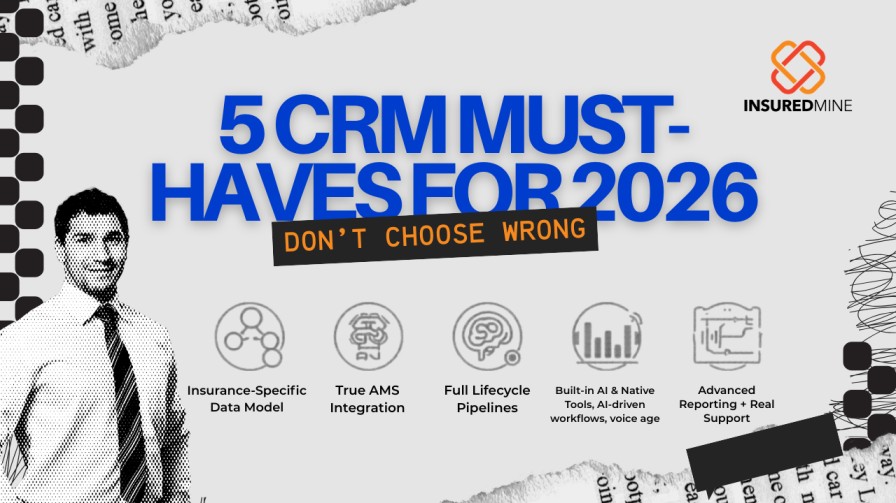
Here are the five things every independent agent should demand — and why they matter more now than ever.
1. A Data Model Built for How Insurance Actually Works
Most CRM platforms were designed for B2B sales. Their data model reflects that: one contact, one deal, one outcome. A personal lines agency running high-volume auto and home can function in that model. The moment you introduce commercial complexity — a business with multiple decision-makers, multiple policy lines, multiple carriers, renewal dates that do not align — a contact-based model collapses.
An account-based model with full hierarchy support is not a feature upgrade. It is the architectural foundation that makes everything else possible: accurate cross-sell identification, meaningful renewal automation, producer performance reporting that reflects your actual book, and a client view that shows the full relationship — not a fragmented set of contacts.
Parent accounts, subsidiaries, multi-location commercial clients, family accounts with multiple named insureds — all connected, all visible, all reportable. This is what agencies growing beyond personal lines need from day one.
What the right data model enables:
- Account hierarchy — parent/subsidiary/family/multi-location natively supported
- Multiple contacts per account — all connected to the same policies and carriers
- Native carrier and policy-level fields — not generic deal fields repurposed for insurance
- Full customer 360 — policies, documents, communication history, tasks, renewals in one view
2. Integration With Your Actual AMS — All of Them, Not Just the Convenient Ones
Your AMS is the authoritative source of policy data, client records, and carrier relationships. A CRM that does not integrate natively with your AMS is a second database you maintain manually — with duplicate entries, synchronization errors, and automation that fires on incomplete data.
This is where the conflict of interest becomes concrete. When a CRM vendor also owns the AMS platforms your agency runs on, they control which integrations get built, how deep they go, and what they cost. There are CRM products being aggressively marketed to large independent agencies today that do not integrate with the AMS those agencies actually run — not because the integration is technically difficult, but because building it is not in the vendor’s interest.
Verify the integration before evaluating anything else:
- Is it native — not a workaround, not Zapier?
- Is it bi-directional and real-time?
- Does it sync rich data — policies, documents, history, renewals — not just contact records?
- What happens to the integration if the vendor relationship changes?
3. Full Lifecycle Pipelines — Not Just a Sales Pipeline
A CRM that only manages sales is managing a fraction of your agency’s operation. The real money in independent insurance is in retention — renewals, cross-sell, and avoiding cancellations. A platform that treats all of these as variations of the same sales pipeline does not understand your business.
New Business, Renewals, Cancellations, Claims — each deserves its own dedicated pipeline with its own automation logic, its own reporting, and its own triggers. Renewal tasks should be auto-created from AMS data. Cancellation workflows should flag at-risk accounts before they churn. Claims pipelines should keep producers informed without manual updates.
Beyond pipelines: automation flexibility matters equally. Can you edit automations directly inside the pipeline view? Can you build list campaigns that segment your book by carrier, line, or account category? Can you run bulk text campaigns for renewal reminders? Can you trigger follow-ups only for clients who did not respond — rather than blasting your entire book?
Advanced marketing automation also means knowing what is working. Bounce rates, spam flags, open rates, click rates — this data is what separates smarter engagement from blind outreach.
Lifecycle capabilities that protect your book:
- Dedicated pipelines for New Business, Renewals, Cancellations, and Claims
- Renewal tasks auto-created from AMS data — no manual setup
- Conditional follow-up logic — trigger only for non-responders
- Deep marketing tracking — bounces, spam, opens, clicks — not just sends
- Pipeline automations editable directly inside the pipeline view
4. AI and Native Tools That Are Actually Built Into Your Workflows
Every software company claims AI in 2026. The question is not whether a CRM uses AI — it is where that AI lives in your daily operation and what it actually does for your producers.
Meaningful AI for an independent insurance agency means: an AI voice agent that handles inbound calls, makes outbound follow-up calls, and logs conversations automatically — without a producer lifting a finger. It means cross-sell prediction that identifies the right clients for the right products at the right time. It means email and conversation summarization that saves producers time on every client interaction. These are not features added on top of a CRM. They are workflows that change what producers can accomplish in a day.
The same principle applies to tools like e-sign and forms. AgencyZoom offers e-signature — but requires every agent to maintain an individual DocuSign account, and has no workflow integration. A native e-sign solution means: policy document ready → auto-send for signature → track status → update AMS when signed. One workflow, no manual handoffs, no third-party dependencies per agent.
Native forms go further still: a client fills a form → a deal card is auto-created → a task is assigned → an automation sequence fires → the CRM is updated → the AMS is updated. Zero manual data entry. Zero dropped balls.
Every third-party dependency you add is a cost, a point of failure, and a workflow that exits your platform before it is complete. Demand tools that are native.
AI and native tool capabilities that move the needle:
- AI voice agent — inbound and outbound calls, auto-logged
- Cross-sell prediction — AI identifies the right opportunity at the right time
- Email and conversation summarization — saves time on every client interaction
- Native e-sign integrated with AMS and workflows — no DocuSign per agent
- Native forms with full automation chain — form → task/deal → automation → CRM → AMS
- Client portal — full policyholder access to policies, payments, and communication on mobile
5. Reporting That Drives Decisions and Support That Stays With You
Standard reporting — sales by producer, by carrier, by line — tells you what happened last month. Decision-grade reporting tells you what to do next month.
Carrier goal tracking shows where you stand against production commitments in real time. Pipeline leaderboards create producer accountability without a weekly meeting to surface it. Revenue forecasting and pipeline conversion rates turn your CRM data into strategic inputs. And an agency-wide dashboard aggregated directly from AMS data — not from what your producers manually enter — gives you an objective view of your entire book.
Agent usage and activity tracking is equally important. Knowing which producers are using the system — and how — is essential for agency owners who invest in training and expect adoption. Platforms that limit reporting to sales and goal tracking only are telling you something about what they think your management job is.
Support follows the same logic. After AgencyZoom’s initial setup phase, ongoing support reverts to chat-only. No dedicated account representative. No customer success manager. Phone access or a CSM costs extra. For a growing agency actively adding producers, building workflows, and expanding its book — chat-only support is an operational constraint.
And training delivered by outsourced third parties following rigid, fixed processes is not the same as training from people who use the system every day and can adapt to how your agency actually operates. That difference shows up in how well your team actually uses the platform — which is the only thing that matters.
Reporting and support that reflect a real agency partnership:
- Carrier goal tracking, revenue forecasting, pipeline conversion rates
- Agent usage and activity tracking — not just sales and goals
- Agency dashboard aggregated from AMS data — objective, complete, current
- Dedicated account rep / CSM — included, not upsold
- 1-on-1 training from system experts — included on all plans, flexible to your operation
What This Week Actually Revealed
When a vendor removes a competitor from a conference rather than competing on the trade show floor, they are telling you something important about their confidence in their own product.
The independent agents at that conference — managing complex commercial books, running sophisticated AMS platforms, needing AI embedded in workflows and full lifecycle pipeline management — are exactly the agencies that benefit most from a real comparison. They deserve to ask hard questions and make informed decisions.
Preventing that comparison is not a product strategy. It is an admission.
We were outside the conference with coffee and real conversations. The industry’s response confirmed what we already knew: independent agents are paying attention, they value transparency, and they are not willing to have their technology choices made for them.
The Standard Is Clear
A data model built for commercial complexity with full account hierarchy. Integration with your actual AMS — all of them, natively. Full lifecycle pipelines from new business through renewals, cancellations, and claims. AI and native tools built into workflows — not bolted on through third-party accounts. Reporting that drives real decisions. Support that stays with you after the contract is signed.
These are not aspirational features. They are the baseline for a platform that is genuinely built around your agency’s growth — not a vendor’s market strategy.
If you want a CRM, there are options.
If you want a scalable operating system for your entire agency — one that grows with your complexity, integrates with your systems, and has no incentive other than your success — the standard is clear.
See How InsuredMine Stacks Up
Feature-by-feature. Use case by use case. No marketing spin.
→ Read the full comparison: insuredmine.com/insuredmine-vs-agency-zoom
→ Request a demo: insuredmine.com/demo
→ Try for $1: insuredmine.com/get-started