NPS
NPS


Guest Contributor: Ray Huang, VP of Marketing, Canopy Connect
A prospect calls in for a quote. Somewhere in the next twenty minutes, someone on your team
asks them to recall their current coverage, their deductible, their driving history—details that
already exist, verified, in a system the prospect logged into last year.
They’ll get bits of it correct and guess at the rest. And the quote you build on top of it will only be
as good as what they remembered on the phone.
What changes when the data shows up already verified
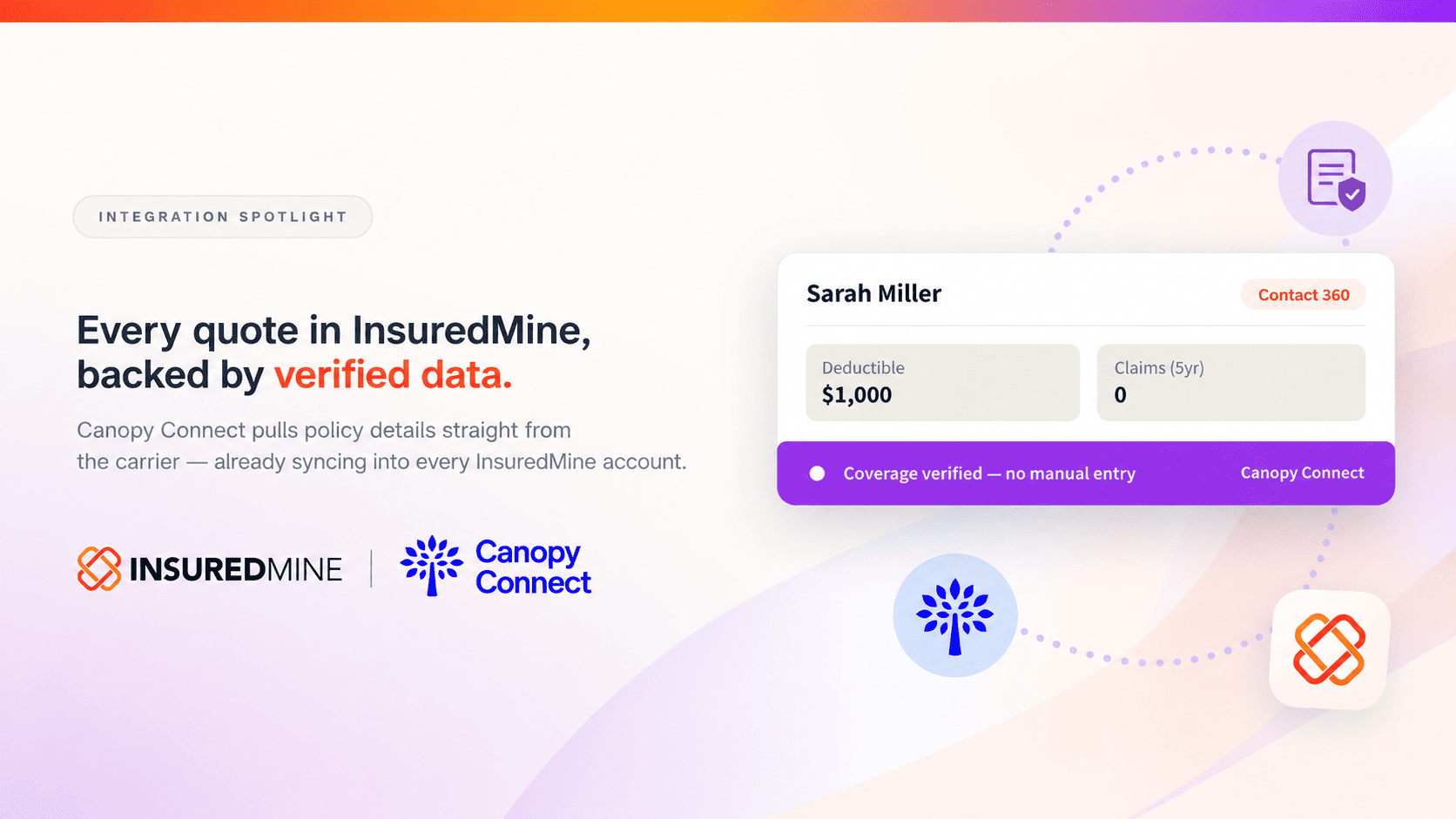
Canopy Connect closes that gap by pulling policy details straight from the prospect’s current carrier—coverages, drivers, claims history, the full picture, verified rather than recalled.
Connected to InsuredMine, that data lands directly in the CRM record, so a producer isn’t re-keying anything or promising to call back with details that should already be on file.
That completeness does more than confirm what was asked about. A prospect on the phone might only bring up their auto policy, but the full data pull will show a homeowners policy that lapsed last spring, or a second vehicle on the account with no coverage listed at all. None of that surfaces in a typical intake call, because nobody knew to ask. Getting the complete picture turns the first conversation into more than a quote request. It becomes the start of a thorough account review.
It pays off before and during the important conversations. A producer can move from “tell me about your policy” to “here’s what I can improve” in the same call, instead of an email three days later. When a proposal reflects a prospect’s actual coverage instead of their memory of it, the value is easier for them to see too.
All of that comes down to fixing the actual bottleneck: quote intake is one of the highest friction points in the sales cycle, and a delay of even one day can cost an agency the lead to a competitor who moves faster. Canopy Connect closes that gap on both ends. Data that used to take a callback cycle of a day or more now lands in seconds, so an agency can be first to respond with a real answer instead of a promise to follow up later. A producer also walks into the call with a complete account picture which makes for a sharper, more competitive proposal.
The time saved runs in both directions, too. The prospect isn’t stuck reciting policy numbers from memory, so the call that used to take three days and multiple callbacks turns into an efficient quoting experience.
Where this actually saves time
The InsuredMine side goes beyond storage.
Its Canopy Connect Analytics dashboard gives producers visibility into every request—how many have been sent, whether customers have opened or clicked them, and which policy pulls are complete or still pending.
Once pulled, policy details, documents, claims, drivers, and other account data are available in Account360, Contact360, or the pipeline, so producers can follow up on outstanding requests and work from a complete account picture without leaving the CRM.
Why the receiving system matters as much as the data
Verified data is only as useful as the system catching it. Canopy Connect pulls a wide, detailed field set—coverages, drivers, claims, property details—and not every CRM has a place to put all of it. When a platform can’t support a field, nothing alerts the agent. The field doesn’t show up, and nobody notices until a producer goes looking for a detail that should have synced and finds nothing there.
InsuredMine is built to hold the full field set Canopy Connect brings in, so nothing gets dropped on the way in. For fields without an obvious home, InsuredMine’s search and map function lets an agency map them manually in a few clicks, instead of losing them or building a workaround.
The enrichment only pays off when the receiving system can actually use what’s being sent.
The job the data clears room for
The producer’s job stays the same: read the prospect, find the gap in their coverage, make the case for filling it. What disappears is all the time wasted on data collection, so the conversation arrives at the part that matters faster.
If your team is still building quotes off what a prospect may or may not remember on a phone call, imagine what would change if that call started with the verified data already in front of you.