

 NPS
NPS


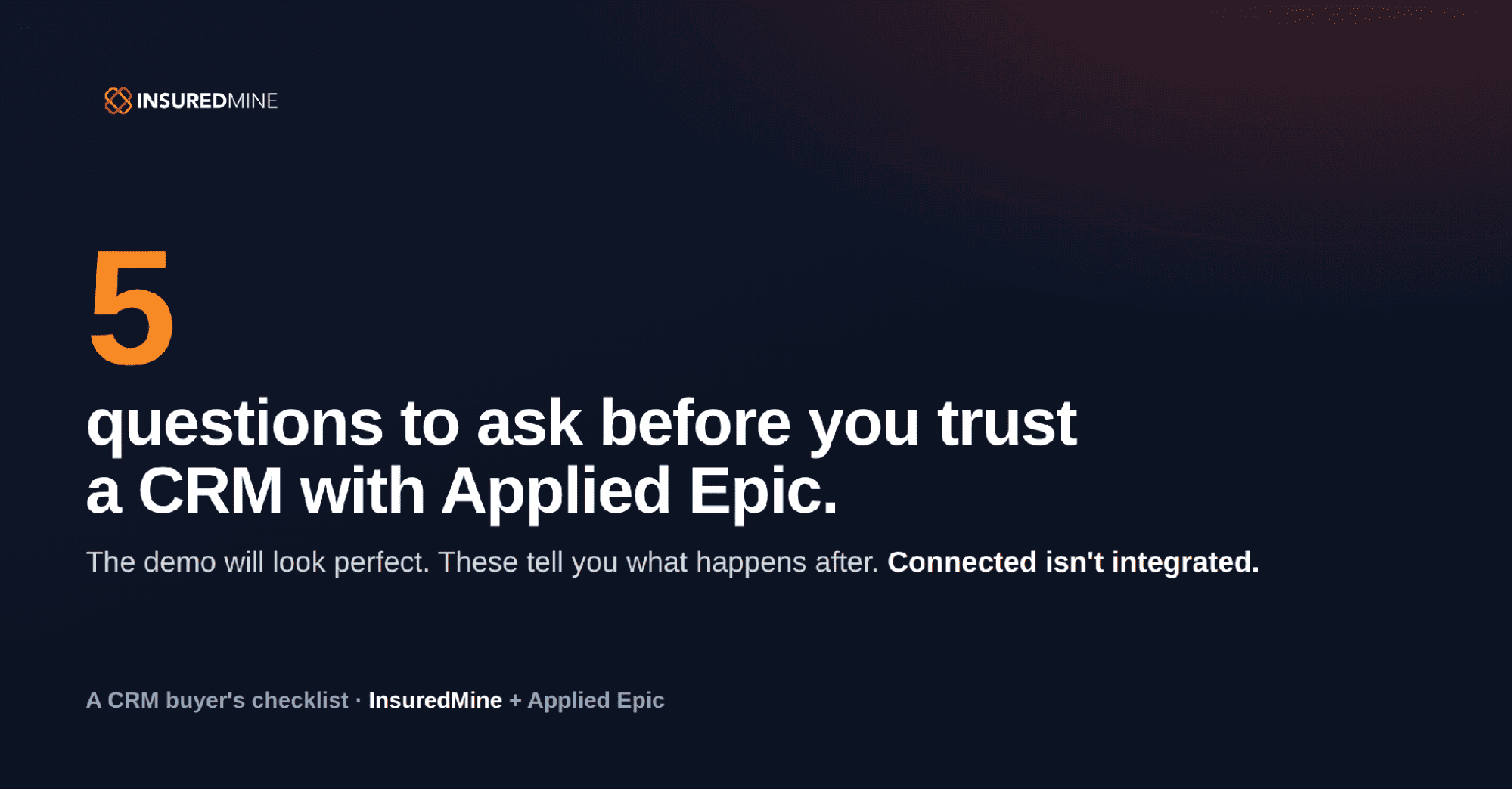
The demo will look perfect. These five questions tell you what happens after it.
A driver gets added to a policy over the phone. Twenty seconds — logged, done. Three weeks later there’s a claim, and the file doesn’t have the change. The sync between the CRM and Epic had broken quietly after an update, and nobody noticed. What looked like a routine endorsement is now an E&O conversation — because a twenty-second call never reached the system of record.
This isn’t a rare failure. In the Big “I” E&O program’s claims data, failure to procure coverage is roughly 30% of all agency claims — more than three times any other cause. Invisible workflow failures have a way of becoming very visible claims. And it traces back to the distinction this whole series has circled: connected isn’t integrated. If the day’s activity doesn’t flow back into Epic on its own, your team becomes the integration — re-typing, reconciling, hoping nothing slips.
Last week, an agency three years past that gap — we called her Elena — named the one thing she’d do differently if she were shopping today: ask a single question before sitting through any demo. Does it write back to Epic, or only read from it? We promised the rest of the list this week.
Here it is — five questions to take into any demo.
Marcus, the principal we’ve followed who’s still weighing the switch, doesn’t need another story; he needs a way to decide. Every one of these is really the same question asked five ways: does this CRM survive contact with how your agency actually runs, or just the vendor demo?
1. Does it write back to Epic — or only read from it?
This is Elena’s question, and the one everything else rests on. Pulling data out of Epic is the easy half; most tools manage that. The real test is the return trip: does a note logged in the CRM land back in Epic without anyone re-typing it? A one-way sync dressed up as integration looks flawless in a demo and fails quietly in production — it shows up as a CSR asking a client to repeat what they already told the producer, because the two systems never actually talked. Answer this one before you look at anything else.
2. When the sync breaks, who finds out first?
Every integration breaks eventually — an Epic update ships, a field mapping shifts, a connection drops for an hour. The question isn’t whether that happens; it’s what happens next. Does someone get alerted before a policy note goes missing, or does the agency find out three weeks later when a claim gets denied? Ask it plainly: when the sync breaks at 2 a.m., who’s watching — and what does the alert actually trigger?
3. What happens when Epic changes underneath you?
Applied ships updates on its own schedule, not the vendor’s. Whether the integration is “native” or “connector-based” matters less than one thing: does it keep working through an update it didn’t control — and how fast does anyone notice if it doesn’t? Sometimes it’s not even a full outage; a renewal date pulls into the wrong column and everything looks fine until someone acts on bad data. By then it isn’t an IT problem. It’s client-facing.
4. Does it hold up as the agency grows?
Scaling isn’t just more seats. It’s more producers, more policies in force, more automation running at once — and every one of those adds load to the sync, not just to the headcount. A connection that holds at 20 users can start dropping records at 150. Ask what the platform looks like at 60 employees versus 20 — not in theory, but for a real agency that made the jump and can tell you what happened to sync reliability along the way.
5. What do the agencies actually running it say?
Every marketing page calls its CRM reliable. Agencies running it day to day, on Epic specifically, will tell you what really breaks — but only if you ask for references from Applied Epic shops, not general CRM customers. Push past “are you happy”: ask what broke in the first 90 days, and whether the vendor caught it or their own staff did. That answer tells you where the monitoring actually lives.
Notice what’s not on the list: whether the integration is native, connector, or middleware. That’s an architecture debate, and it isn’t the thing that bites you. What bites you is accountability — who owns the sync when it fails, who’s watching it, and how fast your agency finds out. A software license shows up on the invoice. A broken sync shows up somewhere else entirely: in re-entered records, in a renewal flag nobody saw, in an E&O claim nobody budgeted for.
Ask these five of any CRM you’re weighing against Epic — including ours. We built InsuredMine’s sync natively against Epic’s data model for one reason: we didn’t want to be the vendor whose customer finds out from a client that something broke. Dana and Elena — the agencies in this series who closed the gap years ago — would pass every question on this list. That’s the bar.
Which brings us to the question every Epic agency is suddenly being asked from every direction: what’s your AI plan? Next week, we start there — because the answer, it turns out, depends on everything we just covered.
Take these five into your next demo. If you’d like to see how InsuredMine answers them against your own Epic data, book a 20-minute walkthrough: [ Contact us ].
Or bring them to Booth 231 at AppliedNet 2026 — the Gaylord National Resort, National Harbor, MD — this September, and put them to us in person.
New to the story? This series follows Applied Epic agencies at three stages — Marcus’s in Florida, still living the gap; Dana’s in California, two years past it; and Elena’s in the Midwest, three years past it. It began with one question: how much of what your producers do all day ever actually reaches Epic? → Start at the beginning with [Part 1], then [Part 2], [Part 3], [Part 4], [Part 5], and [Part 6].