

 NPS
NPS


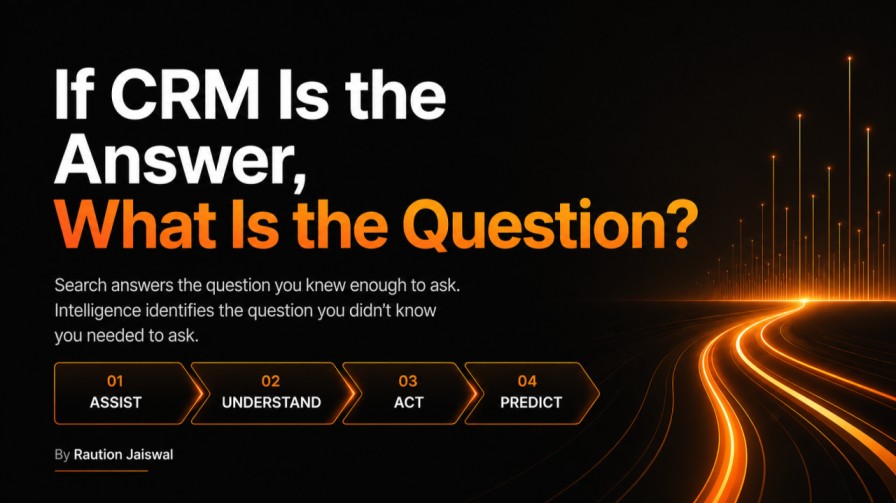
Search answers the question you knew enough to ask.
Intelligence identifies the question you didn’t know you needed to ask.
That distinction is going to reorganize the agency technology market.
For the last 20 years, agencies largely asked:
“Where do I manage my customer relationships?”
CRM was the answer.
Store the customer. Track the opportunity. Record the activity. Run the report.
That was valuable.
But AI is changing the question itself.
The question agencies should be asking in 2026 is:
“What should I know, what should I do, and what should happen next across my book of business?”
And once the question changes, CRM alone is no longer the answer.
From Search to Intelligence
There is a lot of excitement right now about putting AI on top of insurance data.
Ask your book a question.
Search your customers conversationally.
Find accounts matching certain criteria.
Useful.
We are building it too.
But don’t confuse an AI search box with an AI strategy.
Imagine asking:
“Show me my commercial accounts renewing in the next 60 days.”
Good.
Now imagine your system telling you — without being asked:
“These 14 accounts need attention this week.”
“$186,000 of revenue is showing early risk signals.”
“These 31 customers have Home but no Auto.”
“These five producers should focus on these seven customers today.”
That is no longer search.
That is intelligence.
The Four Levels of AI: Assist, Understand, Act, Predict
At InsuredMine, this has led us to think about AI across four levels.
ASSIST
Help me write.
Rewrite the email. Summarize the notes. Translate the message. Turn speech into content.
Extremely useful.
But let’s be honest:
This is table stakes.
Every software company will have it.
UNDERSTAND
Now AI starts understanding the customer.
Summarize the account.
Explain what changed.
Identify sentiment.
Let me conversationally query my book.
This is where fragmented data starts becoming context.
But even here, the interface is becoming easier to reproduce every month.
The search box isn’t the moat.
So there’s no point building a fence around it.
ACT
Now it gets interesting.
Don’t just tell my team what happened.
Do something about it.
- Draft the renewal communication.
- Create the task.
- Trigger the workflow.
- Launch the campaign.
- Send the text.
- Make the AI voice call.
Put the action in front of the right person.
And where it matters:
AI recommends. Human approves. System executes.
Now AI isn’t sitting beside the CRM.
It is operating the business with you.
PREDICT
This is where real differentiation begins.
Don’t wait for my employee to search.
- Find the risk.
- Find the coverage gap.
- Find the customer whose behavior has changed.
- Find the revenue we are about to lose — and the revenue we should be winning.
Then prioritize it.
Because agencies don’t need more information.
They already have too much.
The goal is simpler — and much harder:
Tell me where my next 30 minutes will create the most value.
That is a very different product philosophy.
Which brings me back to the original question.
Stop asking:
“Do we have a CRM?”
Start asking:
“What is our CRM actually doing for us?”
The old CRM told you what happened.
The next generation should tell you what should happen next.
And eventually, help make it happen.
Four Questions to Ask Your CRM
So ask four questions of your system:
Is it recording what your people did — or determining where they should focus?
Does it find revenue hidden in your existing book?
Can it execute the next best action, not just suggest it?
And does it get smarter because of the outcome?
If the answer is no four times, you don’t have an AI strategy.
You have a database with a chat window.
This is also why agencies should stop settling for slow innovation.
AI has dramatically reduced the cost and time required to build software.
So when your technology vendor says:
“It’s on our roadmap.”
“We’re thinking about that.”
“That’s coming next year.”
Ask a harder question:
Why?
You are already paying them.
Push them. Demand more.
And if they aren’t sure what to build next…
Send them our feature list. 🙂
Seriously.
Copy us.
Build it.
Take it to your customers.
I would much rather compete in a market where everyone is innovating aggressively than watch agencies accept outdated technology simply because switching is inconvenient.
Your switching cost should never become your vendor’s innovation moat.
That is bad for the agency.
And ultimately bad for the industry.
At InsuredMine, we don’t believe the destination is a CRM with a few AI buttons attached to it.
We are building toward a continuous intelligence loop:
PREDICT what requires attention ↓ UNDERSTAND the complete customer context ↓ ASSIST with the right response ↓ ACT through communication, workflow or voice ↓ MEASURE what happened ↓ LEARN ↓ PREDICT BETTER
That feedback loop is far more interesting to me than any chatbot.
Because a chatbot gives you an answer.
A learning system improves the business.
Don't Protect the Doorway. Build the House.
And this intelligence should not be trapped inside one interface.
Today, a user may access it inside InsuredMine.
Tomorrow, perhaps through ChatGPT, Claude, Outlook, voice, mobile — or an interface we haven’t imagined yet.
Which is why I increasingly believe:
Don’t protect the doorway. Build the house worth entering.
Protect what actually matters:
- Your proprietary data.
- Your insurance-specific context.
- Your integrations.
- Your signals.
- Your ability to act.
- And the learning loop created from millions of decisions.
AI is making software easier to build.
Which creates an interesting paradox:
The easier features become to build, the less impressive having features becomes.
The moat moves deeper.
So yes:
Build the chatbot.
Build the search.
Build the copilot.
We are.
But don’t confuse the doorway with the house.
What to Ask Your Vendor in 2026
If you are an insurance agency evaluating technology in 2026, don’t settle for:
“Yes, we have AI.”
Ask:
What does it understand?
What can it predict?
What can it actually do?
What business outcome can it prove?
And perhaps the most uncomfortable question of all:
“If all of this is possible today, why doesn’t my current CRM already do it?”
Ask your vendor.
Ask them to build it.
Tell them to copy us.
Or come talk to us.