

 NPS
NPS


It is 2:14 AM.
I should be asleep.
Instead, I am staring at AI adoption curves in insurance, and one thought will not leave me alone:
The Question Everyone's Asking Is Wrong
We keep asking, “Will AI replace the agent?”
I think that is the wrong question.
The scarier question is this:
What happens when AI makes every agency look equally good — and the only thing left to differentiate on is trust that took a decade to build?
For the last six years, I have been building software that sits on top of AMS systems — Applied Epic, AMS360, HawkSoft, Sagitta, and others — for independent P&C agencies.
Through InsuredMine, we now see more than $20B in active premium across our active agency clients.
That has given me a front-row seat to something most of the AI-in-insurance conversation is missing.
Everyone is racing to bolt AI onto the transaction.
Faster quoting. Auto-generated summaries. AI voice agents that never sleep. Emails written in seconds. Follow-ups triggered automatically.
All of that is useful.
Some of it is necessary.
But I do not think it is the most important part.
What Agency Memory Actually Protects
Everyone in insurance says the same thing:
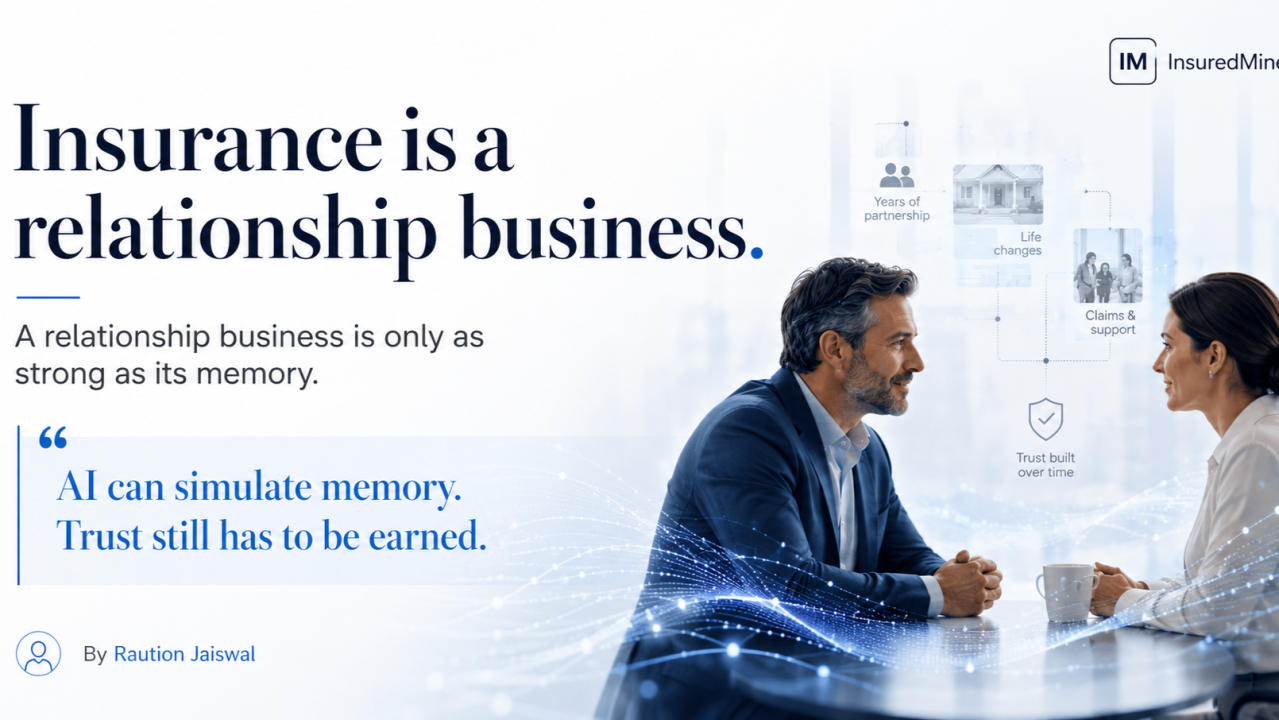
Insurance is a relationship business.
And they are right.
But the longer I have worked with independent agencies, the more I have realized something deeper:
A relationship business is only as strong as its memory.
Because what makes an agency relationship valuable is not just that someone knows the client’s name.
It is that the agency remembers the context.
The agent who remembers that your son just started driving. The account manager who knows you always get nervous before renewal. The producer who understands why you left the last carrier. The service team that remembers the claim from three years ago, the difficult conversation last renewal, the coverage gap that almost became a problem, and the promise someone made but never wrote down clearly.
That memory — spread across thousands of small human interactions — is what turns a transaction into trust.
And for decades, that has been the real moat of the independent agency channel.
Not just access to markets.
Not just local presence.
Not just service.
Memory.
But agency memory has always been fragile.
Some of it lives in the AMS. Some of it lives in email. Some of it lives in call notes. Some of it lives in a producer’s head. Some of it disappears when a person leaves. Some of it is remembered too late — after the renewal is already at risk.
When AI Can Simulate a Decade of Trust
AI changes that equation.
Because AI is suddenly very good at collecting, summarizing, and simulating memory.
A well-trained model can summarize a client’s history. Predict the next likely need. Draft a personal email. Surface cross-sell opportunities. Create a renewal touchpoint that sounds like it came from someone who has known the client for years.
So here is the question that keeps me up:
If AI can simulate the appearance of a decade-long relationship in a single API call, what exactly are agencies protecting anymore?
Earned Closeness vs. Simulated Closeness
I do not believe the answer is “nothing.”
I believe the answer is that the bar just moved.
The future advantage will not come from simply having relationships.
It will come from proving that the relationship is still real.
That means agencies will need better signals.
Retention signals. Book intelligence. Producer accountability. Service visibility. Renewal risk indicators. Client engagement history. The data trail that proves the agency is not just sending automated touches — it is actually paying attention.
Not dashboards for the sake of dashboards.
Receipts.
Evidence that says:
This is not simulated closeness. This is earned closeness. And here is the operating system behind it.
The agencies that win the next decade will not be the ones with the flashiest AI chatbot.
They will be the ones that use AI to understand their own book more clearly than anyone else does — and then have the discipline to act like humans with that insight.
Not automations pretending to be human.
Humans made sharper by intelligence.
That is a harder story to tell than “AI-powered insurance platform.”
It does not fit neatly into a launch tweet.
But it is the version of the future I actually believe in.
It is also a big reason I built InsuredMine the way I did — bootstrapped, independent, and without outside capital. I wanted the freedom to build for the slower, harder truth instead of the version of AI that is easiest to demo.
And honestly, I am still not sure I am completely right about all of this.
That is usually when I know something is worth writing down.
It is also why I have started writing a book.
Working title:
The Intelligent Book: How AI Is Rewriting the Rules of the Relationship Business
It is not meant to be another “AI will change everything” playbook.
It is my attempt to wrestle with a harder question:
What does a relationship business become when intelligence is cheap, memory can be simulated, and the only scarce thing left is judgment earned over time?
If you are building, running, or advising an agency — and this resonates — I would love to hear your thoughts.
And if you think I am wrong, I would probably learn even more from that.
2 AM thoughts are better with company.