NPS
NPS


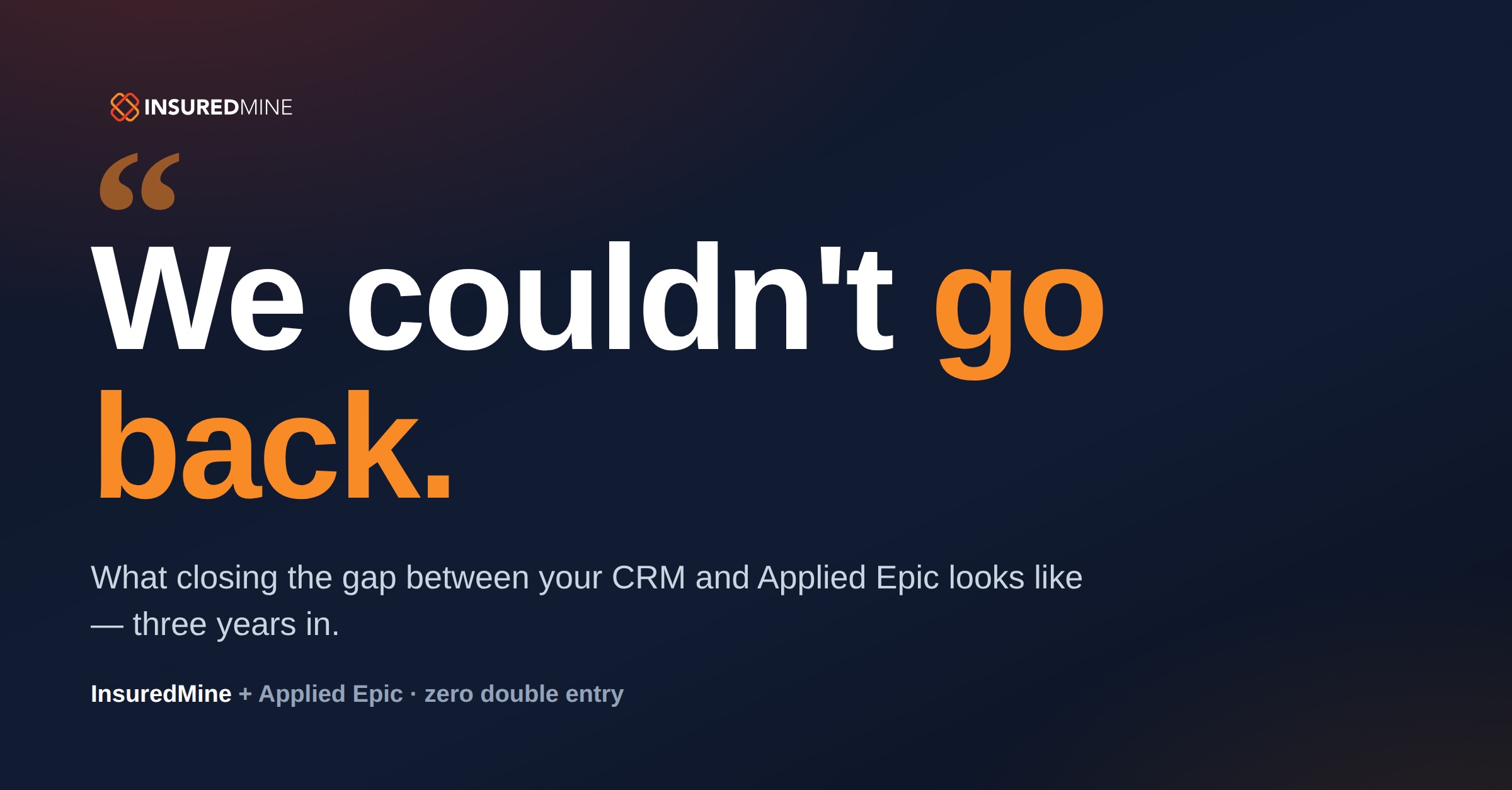
Three years running InsuredMine on top of Applied Epic — what it’s like once the gap between your CRM and your AMS simply closes.
Most agencies on Applied Epic run a CRM beside it — and quietly pay a tax for the two not talking. Producers log the calls, notes, and emails in the CRM; the service team works out of Epic; and the space between them gets closed by hand, one re-typed entry at a time. That space is the gap — the daily work that never quite reaches your system of record.
InsuredMine is a CRM built to close it: a real two-way Applied Epic integration, so what happens in one system shows up in the other without anyone re-keying it. We’ve spent a few weeks on what that’s worth. This week, someone who’s lived it for three years puts it better than we can.
Because a closed gap has one strange property — it goes quiet. There’s no alarm that announces “the record stayed whole today.” The win is the absence of a problem, and absence doesn’t call attention to itself. The only way to see it is to find an agency that’s been on the far side long enough to half-forget the old one, and ask them to remember.
We’ll call her Elena. She runs a 42-person independent agency in the Midwest — about 60% commercial, 40% personal, the kind of shop that’s grown its book by a third in three years and felt every bit of that growth in the back office. She’s three years into running InsuredMine on top of Applied Epic. Here’s what three years looks like from the inside.
Three years ago, Elena’s agency looked like a lot of agencies still do. Two of her account managers spent the better part of a day each week doing nothing but moving notes from the CRM into Epic by hand. “I didn’t think of it as a problem,” she says. “I thought of it as the job.”
Until the Tuesday it became one. A commercial client called a producer to raise his limits and add a second location; the producer logged it in the CRM and moved on. It never reached Epic. The renewal went out on the old terms — and nobody knew until the client asked why his new location wasn’t on the binder. It got fixed. But it was close, and it was the kind of close that keeps a principal up at night. “That one,” Elena says, “was the day ‘the job’ stopped being an acceptable answer.”
It helped that a newer producer had come from a shop with a real two-way system and kept asking the obvious question — why are we doing this by hand? What Elena feared was the fix: a months-long migration, her team relearning everything in the middle of renewal season. That’s not what happened. The accounts came over from Epic, the activity started flowing both ways, the renewal cards began assigning themselves — and within a season, the re-typing simply stopped.
What does an agency look like three years after closing the Epic gap?
What she notices now isn’t a feature. It’s what stopped happening. Nobody reconciles two systems on Friday. No renewal reaches its date without an owner. When a client calls, whoever picks up sees the whole relationship — the last conversation, the open service item, the note the producer left in the field — because it all lives in Epic, and Epic is where they work. “It’s not that we got faster,” she says. “It’s that a whole category of mistake just… left.”
The strangest part, to her, is the newest people. “My last three hires have no idea the gap ever existed. There’s no ‘and here’s how you get it into Epic’ step anymore, so I stopped teaching it. They think this is just how agencies work.” The seam isn’t hidden — it’s gone.
And the two account managers who used to move data? They run the agency’s account-review and renewal-outreach program now — the same hours, pointed at clients instead of screens. It shows up in small moments: a CSR opens a renewal, sees the producer’s note that the client is expanding to a second location, and calls ahead to get the coverage right before anyone’s asking — rounding the account while she’s at it. Multiply that across a book, across a year, and you get Elena’s numbers: a business grown by roughly a third in three years, on the same core team, with no added back-office headcount, and renewal retention up a few points. Growth that didn’t require another seat just to keep the record straight.
Ask her the counterfactual — would you go back? — and the answer is instant. “We couldn’t. Not wouldn’t — couldn’t. Nobody on my team remembers how to work the other way, and I wouldn’t ask them to.”
That’s the part worth sitting with if that’s still your agency. From inside it, the gap doesn’t feel like a crisis — it feels like the job. Elena thought so too, right up until the Tuesday it didn’t.
When I asked her what she’d do differently if she were shopping today, she didn’t hesitate. “I’d ask one question before I sat through a single demo: does it write back to Epic, or only read from it?
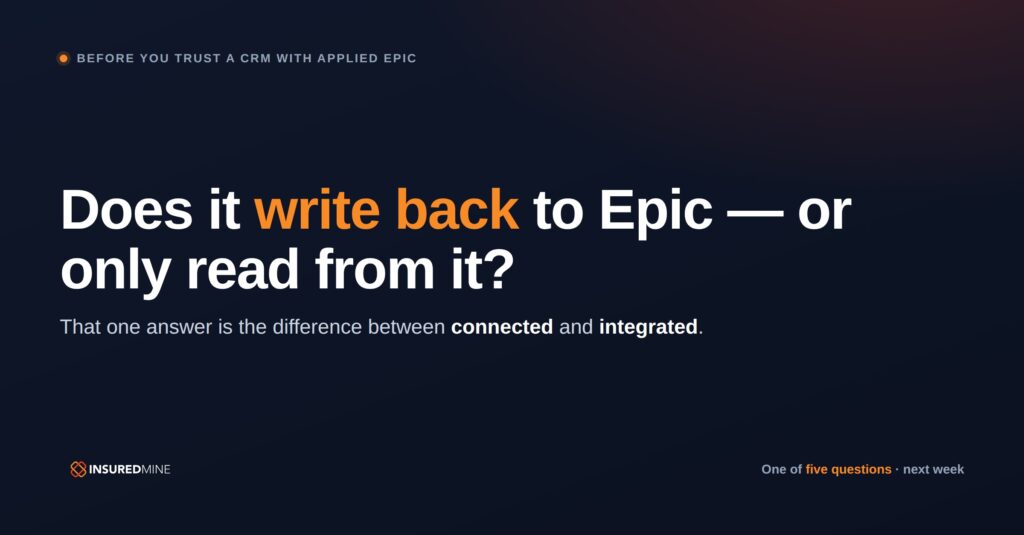
A CRM that only reads is a nicer window on the same gap. Everything I care about — the activity reaching the file, the renewals owning themselves, the record staying whole — starts with that one answer.”
That’s the first of five we’d put to any vendor before you trust them with Epic — the questions that separate a real two-way integration from a prettier version of the problem. Next week, the full checklist.
So if that’s still your agency, you don’t have to take Elena’s word for it — or ours.
The real ones will be at AppliedNet: agency owners telling their own version of this, in person and on the loop at Booth 231, the Gaylord National Resort, National Harbor, MD.
Come hear it firsthand — or see it against your own Epic data first, with a 20-minute walkthrough: Click here.
New to the story? This series follows Applied Epic agencies at three stages — Marcus’s in Florida, still living the gap; Dana’s in California, two years past it; and Elena’s in the Midwest, three years past it. It began with one question: how much of what your producers do all day ever actually reaches Epic? → Start at the beginning with [Part 1], then [Part 2], [Part 3], [Part 4], and [Part 5].