

 NPS
NPS


A client calls about a small change — nothing that seems worth a formal note, so it doesn’t get one. It lives in a producer’s memory instead. Three months later, at renewal, it matters. Nobody can find it, because it was never actually anywhere to be found.
The gap payroll used to close
That’s a small version of a gap that has gotten measurably worse. In J.D. Power’s 2024 U.S. Independent Agent Satisfaction Study [Source], the satisfaction gap between the smallest and largest independent agencies has nearly quadrupled since 2019. From a 36-point difference to 143 points in personal lines, with large-agency satisfaction climbing as small-agency satisfaction fell. Commercial lines told the same story, worse: the gap there went from 2 points to 123.
That’s not a service-quality story. It’s a resource story.
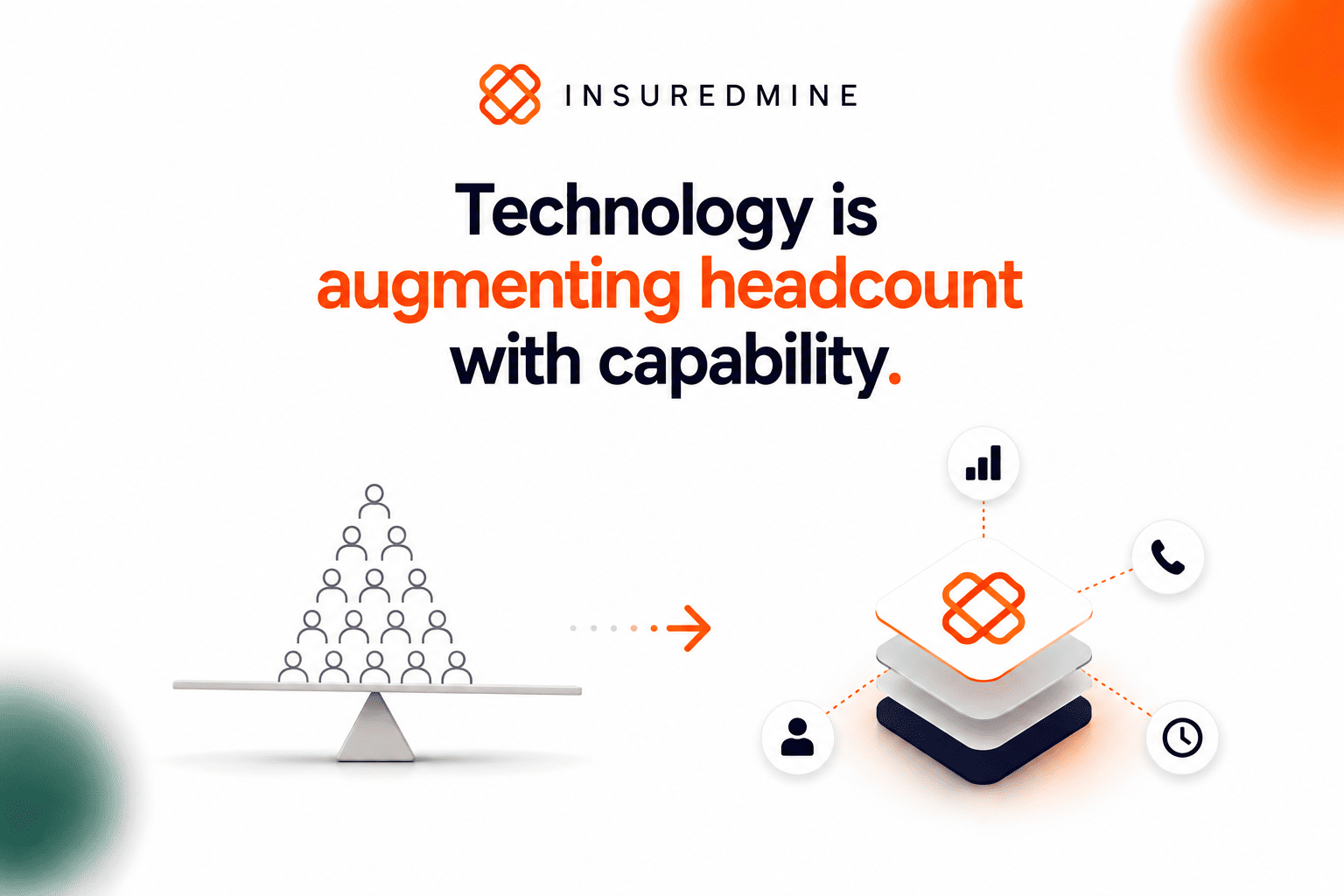
A two-hundred-person brokerage closes it with headcount — a compliance team cross-checking renewals, analysts pulling real-time reads on the book, staff covering phones late enough that nothing goes to voicemail.
None of that is strategy. It’s payroll. A twelve-person agency doesn’t lose the deal because it understands insurance less. It loses it because it never had the staff to see its own book the way the brokerage sees theirs.
That gap is closing, even amid uncertain headwinds.
None of what follows works if the data underneath it is wrong — that’s a different problem, for a different piece. Assume the data is right.
Till now, size decided who had access to real-time answers, after-hours coverage, and compliance discipline — and who didn’t. That’s the part technology is starting to reverse. The clearest evidence is the SBA Office of Advocacy’s tracking of small and large businesses: in February 2024, large businesses were adopting AI at roughly 1.8 times the rate of small businesses; by August 2025, that gap had narrowed to about 1.2 times [Source].
Gaps like that don’t usually move that fast. Electricity took three decades to reach farm households after cities had it. Personal computers took twenty years to reach most homes. This one is moving faster than either — and it’s not a small-business fad. It’s access to capability that used to require a balance sheet a twelve-person agency doesn’t have.
What that looks like on a Tuesday, not in theory
A producer at that same twelve-person shop can now ask their CRM which accounts are renewing soon with no recent contact and get the answer in the time it takes to type the question — the kind of real-time read that used to sit on an analyst’s desk.
A call on a Saturday still gets answered, the reason for it logged, the right person finding it Monday — the kind of after-hours coverage that used to mean a night shift. None of it needed more people. It needed the agency to stop being the only place that information could live.
Those two aren’t hypotheticals. They already have names: Book IQ for the real-time read, IVA — InsuredMine’s voice agent — for the call that doesn’t wait for Monday.
The mid-market and small agencies were never the problem
Say the quiet part: the widening gap in that J.D. Power data didn’t happen because small agencies got worse at their jobs. It happened because carriers and technology both followed the money toward agencies big enough to justify the investment. The agencies benefiting most from what’s changing now aren’t the two-hundred-person brokerages — they already had the staff. It’s the twelve-person shop, the two-year-old startup, the mid-market book that never had budget for a compliance hire, getting handed capability that used to be a line item on someone else’s balance sheet. Scale used to be the moat. It’s turning into something a lot smaller agencies can now match without the headcount to justify it.
The agencies that figure this out first won’t win because they bought more software. They’ll win because team size is no longer the ceiling on what they can see, catch, and act on. The capabilities that once required another hire can increasingly come from the systems they already have.
What’s the last thing your agency couldn’t do because of headcount — and is that still true today? Worth finding out on your own book, not a hypothetical one. Book a walkthrough → [Contact us.]