

 NPS
NPS


The Execution Gap
Every insurance agency we’ve spoken with over the past several years has the same data problem.
Not too little data. Too much of it- sitting still.
Renewal dates in the AMS. Policy values in a spreadsheet. Engagement history in an inbox. Coverage gaps visible to anyone who looks. Except nobody looked, because nobody had time to go looking. At-risk accounts that didn’t announce themselves. Cross-sell windows that opened and closed while the team was busy with something else.
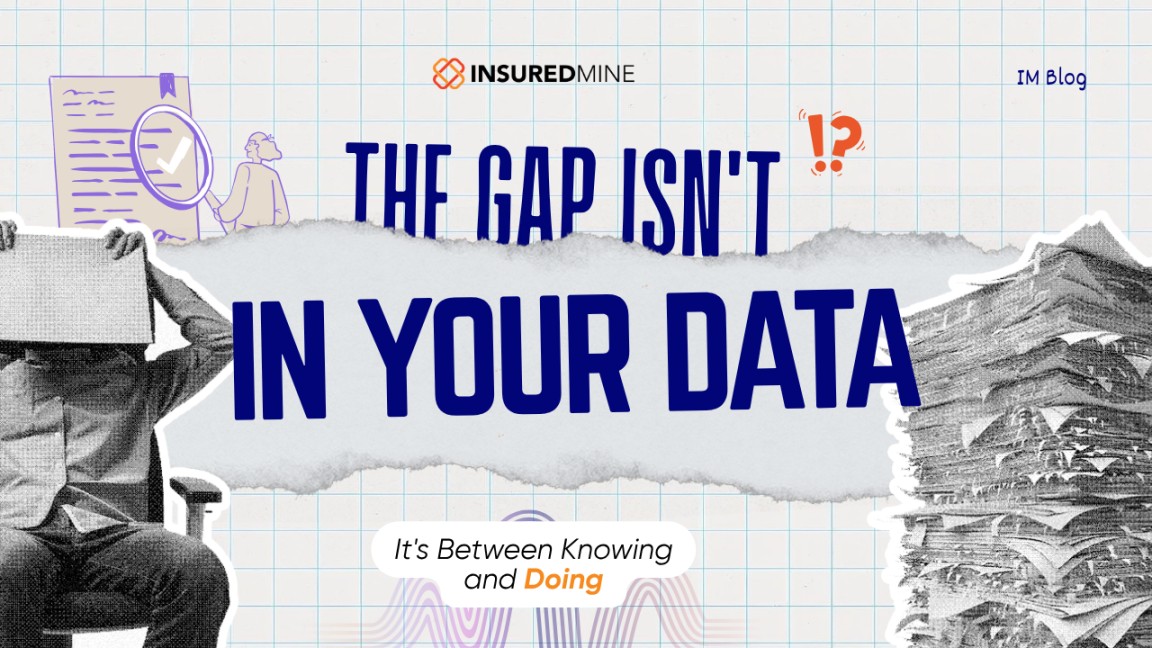
The data was never the problem. The action was. The gap is between knowing and doing.
AMS and CRM Changed Insurance Agencies
The Agency Management System was a genuine achievement, policies, carriers, documents, billing, all in one place, accurate, audit-ready. For decades, that was enough. When growth meant writing more new business, the AMS was the right tool for the job.
Then the industry changed. Acquisition costs climbed. Retention got harder. The playbook that worked for a generation- manage the book, wait for renewals, grow by adding headcount- started to break.
CRM platforms arrived to improve communication, pipelines, and outreach. They solved an important problem, but not the one agencies increasingly struggled with. The real bottleneck wasn’t communication. It was execution.
A renewal drifting toward lapse isn’t a data gap. It’s a task nobody started. A coverage gap isn’t an insight to file away. It’s a job with a deadline.
Both generations of software were built correctly for what they were designed to do. Both left the same thing unsolved: someone has to act on the data before it goes stale, and nothing in the stack was built to be that someone.
Three Systems: AMS, CRM, and the Missing System of Action
Today, the agency technology model is evolving.
Agency System | Responsibility |
|---|---|
System of Record (AMS) | Stores operational truth |
System of Engagement (CRM) | Manages communication |
CRM + System of Action | Ensures important work is identified, prioritized, coordinated, and completed |
For agencies, this capability is most naturally delivered as part of the CRM- the system where work is already coordinated across producers, service teams, and marketing.
A System of Record stores information. A System of Engagement manages communication. Neither one decides what needs doing, hands it to the right person, and checks that it got done. That job has always defaulted to people. Producers carrying dates in their heads, account managers running on instinct built from years in the seat- systems like that could only scale as far as a person’s attention could.
Human attention has a ceiling. Software doesn’t.
What "Working" Actually Means
The most honest thing we hear from agency leaders isn’t that their systems are broken. It’s that their systems are working, and things still feel harder than they should.
Producers keep parallel spreadsheets because the official system doesn’t surface what they need before a call. Cross-sell opportunities expire not because nobody wanted to act, but because acting meant going to look for it — and there was always something more urgent in front of them.
Working isn’t the same as helping. A system that holds data correctly but requires manual effort to turn it into action is doing half the job. The cost just doesn’t show up until later, as a renewal that didn’t happen.
A System of Action
A System of Action finds the work, ranks it, routes it, and stays on it until it’s done.
That last part is the distinction that matters. Creating a task is easy. Managing the work behind that task until it reaches completion is much harder. Most systems stop at notification. A System of Action stays involved until the outcome is known.
The term gets used loosely, often for tools that fire off a task when something happens: renewal hits 30 days, send an email. That’s automation. Useful, but only works when reality matches the script.
What we mean is closer to judgment— reading what’s actually happening in a book of business, and deciding what deserves attention. It used to require a person watching constantly. Now the watching is handled, so attention goes only to what actually needs a decision
Operationally it sits between the agency’s data and the people responsible for outcomes. It reads the data, prioritizes what requires attention, routes the work to the right people and workflows, and maintains visibility until that work is complete.
This is where we believe the insurance CRM is heading. At InsuredMine, we’re building an insurance-native CRM with a built-in System of Action that works alongside the AMS to turn operational data into prioritized, accountable work.
What Changes
When the right work is surfaced consistently and followed through, agencies see the outcomes they actually care about.
Renewals start earlier, not because producers got better at remembering, but because the risk surfaces before it becomes a crisis. Retention improves because at-risk accounts get attention before they decide to leave.
The Question Worth Asking
The agencies quietly changing course aren’t chasing novelty. They’re recognizing that the software they built their operations around was excellent at what it was built to do and that what it was built to do is no longer enough.
The question isn’t whether your AMS is broken. It isn’t. The question isn’t whether your CRM works. It probably does.
The question is whether anything in your stack is actually built to act– to take the data your systems already hold and turn it into completed work, without someone having to go looking for it first.
That’s the category we’re building toward.
Curious what a System of Action looks like in practice? Schedule a personalized demo.