

 NPS
NPS


You’ve got a book of business you built one renewal at a time, and some of what you know about those accounts never made it into any system.
Those are not the kind of things a field captures. The client who always negotiates hard right before signing, simply because that’s how their business runs. The one whose “no changes” on the renewal form has meant three different things over three years, and only you know which one because you were the one on the call.
Your CRM, AMS and connected systems have gotten a lot better at seeing.
Systems can now flag lapsed payment, coverage gaps, accounts that have gone quiet. That part’s genuinely useful, most of us were drowning in Excel sheets before this. But somewhere along the way, “it can see this” started drifting toward “it should probably decide this,” and that’s a different claim entirely. Nobody’s said it out loud, but it’s the quiet part of every automation conversation right now.
It shouldn’t decide it.
Not for lack of capability, but because what you do with that flagged account is a judgment call, not a data problem. It’s experience built out of years of “no changes” meaning different things. That doesn’t compress into a rule, no matter how much better the system gets at seeing.
There's a ladder here, and most of the industry is stuck arguing about the wrong rung.
Everyone’s climbing it fast right now. Almost nobody’s stopped to ask how high they actually intend to go.
The bottom rung is automation, a system doing a fixed, repetitive task faster than a person could. Checking a carrier portal for a payment status, pulling a renewal premium or sending a thank you note. Useful, not intelligent; it’s just doing the same click you’d do, minus the click. It’s also expensive to build well, which is why agencies are starting to talk about sharing that cost instead of each building it alone.
The next rung is visibility. Dashboards, audit trails, a workbench that tells you what’s actually happening across your pipeline. Still no judgment. It just makes the decision easier to exercise, by putting the right thing in front of you instead of forty tabs.
Above that is reasoning, a system that looks at your book of business and surfaces what deserves attention: this account’s gone quiet, this renewal has a gap, here’s a draft response if you want one. This is the newest rung, and it’s the one getting the most attention right now, mostly because it’s the first rung that feels a little uncanny. It’s doing the noticing part of your job, that used to eat an afternoon before you got to the part that actually needed you.
And then the top rung- a system that acts on what it noticed. Sends the response, updates the record, triggers the workflow, no human in the loop. Notice what has happened between rung three and rung four: we’ve gone from replacing clicks to replacing judgment. This is the rung everyone’s racing toward, and it’s also the rung that should make you slow down, not speed up.
Here's the part worth being honest about.
Much of what gets marketed as “AI-powered” right now still lives on the visibility rung. The reasoning rung is newer, and it’s arriving through one specific mechanism: AI models getting narrow, permissioned access to the data your CRM already holds; read-only, specific tables, nothing that acts without a person choosing to act on it. You don’t hand a system write access to a client’s file before you’ve proven it can be trusted with read access to it. It is the correct order of operations.
That’s the human argument for holding the line at reasoning. There’s a second one, and it isn’t philosophical— it’s already been written into law.
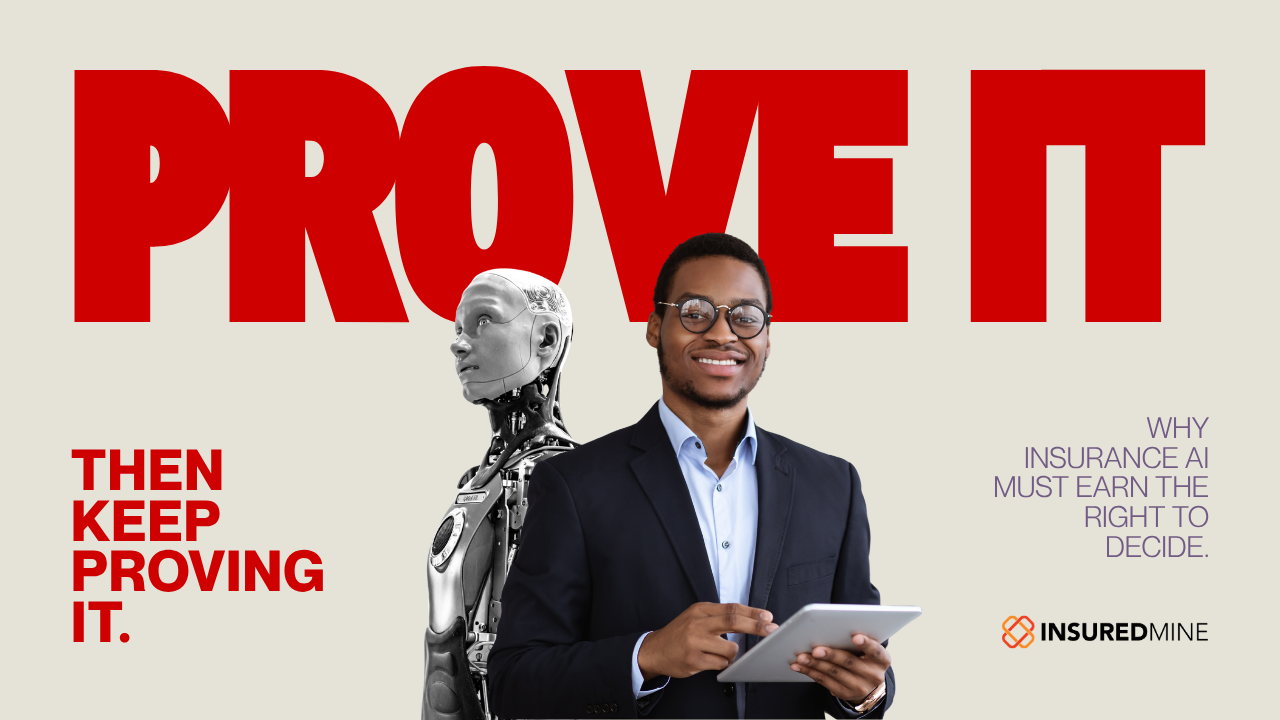
The industry’s answer to “can a machine decide” was never really “yes” or “no”. It was “prove it, and keep proving it”. Nearly half of U.S. states have adopted the NAIC’s Model Bulletin on insurers’ use of AI, requiring a documented AI program with auditing processes, governance frameworks, risk management, and third-party vendor oversight— including human review of AI recommendations before a final decision on high-stakes decisions like claims denials or underwriting declinations. That bulletin is written for carriers, not agencies. But it also holds insurers accountable for AI used on their behalf, not just AI they build themselves (NAIC). As carriers strengthen their own AI governance, those expectations are likely to flow downstream through the same vendor and agency relationships that already govern everything else.
Capability without accountability isn’t a product. It’s exposure. The industry has already said so.
Just not about you yet.
None of this means the top rung stays off-limits forever. It opens exactly as fast as governance, auditability, and demonstrable reliability open with it.
That's not a wall. It's a hinge.
Think of it the way you’d think about a new hire. You don’t hand someone the master file on day one. You watch them handle the small stuff first. The routine renewal, the straightforward claim– and you gradually widen what they’re trusted with as they prove they can carry it. Nobody calls that distrust. It’s just how trust gets built, one demonstrated decision at a time. Automation should earn trust the same way. Slowly, visibly, and in front of witnesses.
That’s the argument for a human in the loop today. The loop itself can still widen as trust is earned. The agencies that get this right won’t be the ones with the most autonomous software. They’ll be the ones who can show their work- every flag, every override, every account where a human chose differently than the system suggested. That is the product, not a compliance footnote.
Prove it. Keep proving it. That’s what trust has always meant in this business. AI doesn’t get a different standard. It gets the same one.