

 NPS
NPS


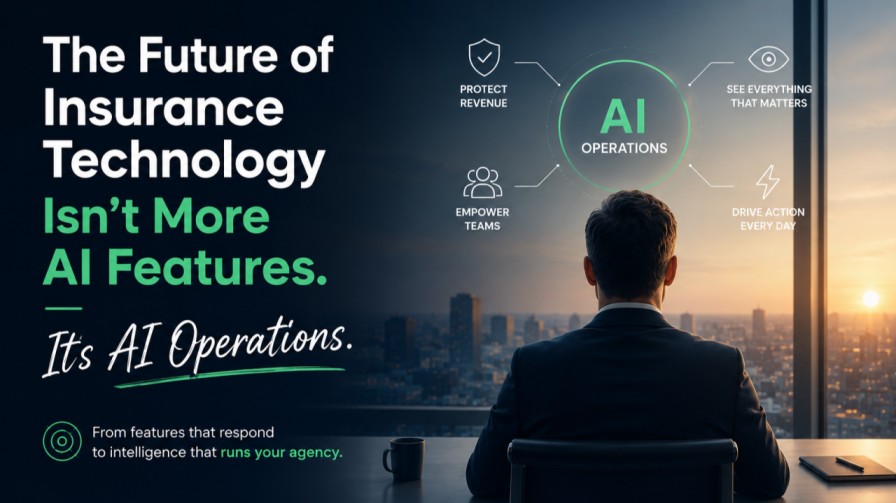
The insurance technology industry has become obsessed with AI features. Every week there’s another announcement:
- AI-generated emails
- AI-account summaries
- AI-powered search
- AI-renewal predictions
- AI-conversation analysis
These are useful capabilities. Many of them genuinely improve productivity. But they’re not a strategy. And after spending the last two years building AI into InsuredMine, studying agency workflows, and watching adoption rates across the industry, I’ve come to a conclusion that may be uncomfortable for many vendors:
We've been building AI features when we should have been building an AI operations layer.
There’s a significant difference. An AI feature answers a question. An AI operations layer helps run the business. That distinction becomes obvious when you think about what agency owners actually worry about every day. They don’t wake up wondering whether their producers can draft emails faster. They worry about questions like:
- Which renewals are at risk of leaving?
- Which clients haven’t heard from us recently?
- Which agents are falling behind without saying so?
- Where are follow-ups being missed?
- Which opportunities are sitting unnoticed inside the existing book?
- Where is revenue leaking today?
These are operational questions. And most AI tools available in insurance today are not designed to answer them. They’re designed to respond when someone asks. The problem is that agency owners don’t always know which question they should be asking.
The Adoption Problem Nobody Wants to Discuss
Across the software industry, AI adoption numbers remain lower than many expected. Some view that as a technology problem.
I don’t. I view it as a design problem.
Most AI capabilities require users to stop what they’re doing, navigate somewhere else, and ask for assistance. In other words, intelligence is hidden behind a button. An AI-generated account summary buried inside a menu is a feature. The exact same summary automatically appearing before a renewal conversation with premium history, policy information, recent communications, and risk indicators already assembled is something entirely different. The capability is identical. The workflow is not.
One requires effort to access intelligence. The other delivers intelligence at the moment a decision is being made.
That’s the difference between an AI feature and an AI operations layer. The future belongs to the latter.
From CRM to Command Center
Historically, CRMs have been systems of record. They store information. They document activity. They help teams track work. That was valuable when data storage was the primary challenge. Today, the challenge is different. Agencies already possess enormous amounts of information. The problem is extracting meaning from it quickly enough to take action. That’s why we’re rethinking AI at InsuredMine around a simple question:
What does an agency owner need to know at 8:00 a.m. to run the business effectively that day?
- Not a dashboard full of charts.
- Not a list of AI tools.
- Not another report.
An operational command center. Imagine opening your system each morning and immediately seeing:
- High-value renewals at risk due to lack of engagement
- Missed client calls without follow-up
- Premium increases that haven’t been explained to policyholders
- Agents accumulating overdue activities
- Opportunities for cross-selling hidden within existing accounts
- Leads that went cold without a documented reason
Not just alerts. Actions. Every insight connected directly to the next recommended step.
- Create the task.
- Assign the owner.
- Launch the outreach.
- Document the follow-up.
- Resolve the issue.
Because intelligence without action eventually becomes another dashboard nobody looks at.
The Hard Lesson We Learned
Building AI forces you to confront a difficult question:Are you solving interesting problems or urgent problems? The two are often confused.
Interesting:
- AI-powered search across the CRM
- AI-generated content recommendations
- AI-assisted policy comparisons
Urgent:
- Identifying clients who replied but never received a response
- Detecting renewals approaching expiration with no outreach logged
- Surfacing accounts showing signs of churn before it’s too late
- Revealing where retention risk is increasing across the book
Interesting problems generate demos. Urgent problems generate outcomes. Agency owners don’t buy software because it’s clever. They buy software because it protects revenue, improves retention, increases productivity, and reduces operational risk. The most valuable AI applications in insurance won’t necessarily be the most impressive. They’ll be the ones agencies can’t imagine operating without.
The Next Decade of Agency Operations
Insurance has always been a relationship business. Success depends on conversations, trust, responsiveness, and consistency. Yet most agencies still rely on a combination of spreadsheets, reports, memory, and manual discipline to make those relationships work at scale. AI’s greatest opportunity is not to make agencies behave more like technology companies. It’s to ensure that the relationship work that should happen actually happens.
- Automatically.
- Reliably.
- Consistently.
At scale.
The agencies that thrive over the next decade won’t necessarily be the ones with the largest sales teams or the biggest marketing budgets.
They’ll be the ones where:
- No renewal slips through unnoticed
- No client inquiry goes unanswered
- No opportunity remains hidden inside the book
- No manager waits until month-end to discover a problem
They’ll operate with continuous visibility. Continuous intelligence. Continuous action. That’s not another CRM feature. That’s a new operating model. And that’s where we believe the industry is heading.
What do you think AI should be doing inside an insurance agency today?
Should it simply make employees faster, or should it actively help agency leaders operate the business more effectively?
I’d love to hear how agency owners, producers, and operations leaders are thinking about this shift.