NPS
NPS



Pulling up a dashboard is now an instinct among agency principals. Ask how their book is doing, or how many insured they have, or how many policies bound, and the numbers are right there. What’s harder to pull up is last Tuesday’s renewal call — the one where the client mentioned they’d added a teen driver, or hinted they were shopping a competitor’s umbrella quote. That one’s more likely to be “probably in a note somewhere.”
Probably. That word is doing a lot, covering for work that happens and never becomes part of the agency’s institutional memory. Nothing dramatic enough to trigger an alarm. The lights are on, calls get taken, renewals get processed and the agency looks like it’s running fine, because nothing about a missed umbrella mention shows up on a dashboard.
It just runs on less than it earned.
If you read Tuesday’s post, you saw one version of this inside Applied Epic. This is the same gap, stripped of the platform. Every agency lives with it.
You know these moments
“Client mentions they’re hiring — might need to bump the workers’ comp.”
“Producer promises to revisit umbrella coverage at renewal.”
“CSR says, ‘I’ll call you back once underwriting gets back to me.'”
None of these are edge cases. They’re Tuesday. Each one is a small bet that somebody will remember to close the loop — a bet the agency makes dozens of times a day without ever framing it as a bet.
Some of the time, memory holds. A lot of the time, it doesn’t fail badly. It just fails quietly. The producer moves on to the next call. The CSR closes the ticket. Three months later, nobody can say for certain whether that client ever heard back, or whether the promise just never left someone’s head.
What it becomes and what it costs
One gap like that is nothing. A book full of them, quietly aging, is a different thing. Agencies don’t lose clients because they forget everything. They lose them after a dozen small promises like these quietly disappear, one at a time, none of them dramatic enough on its own to notice.
It’s not just the relationship that erodes. The umbrella mention that never got quoted was a cross-sell opportunity. The “I’ll call you back” nobody followed up on can become an E&O conversation when it goes wrong. The cost is not only emotional— It compounds into missed revenue, operational risk and renewal leakage.
Producers work hard. The problem is that hard work isn’t the same as tracked work. An agency can’t act on a conversation it doesn’t remember having.
This isn't an AMS problem
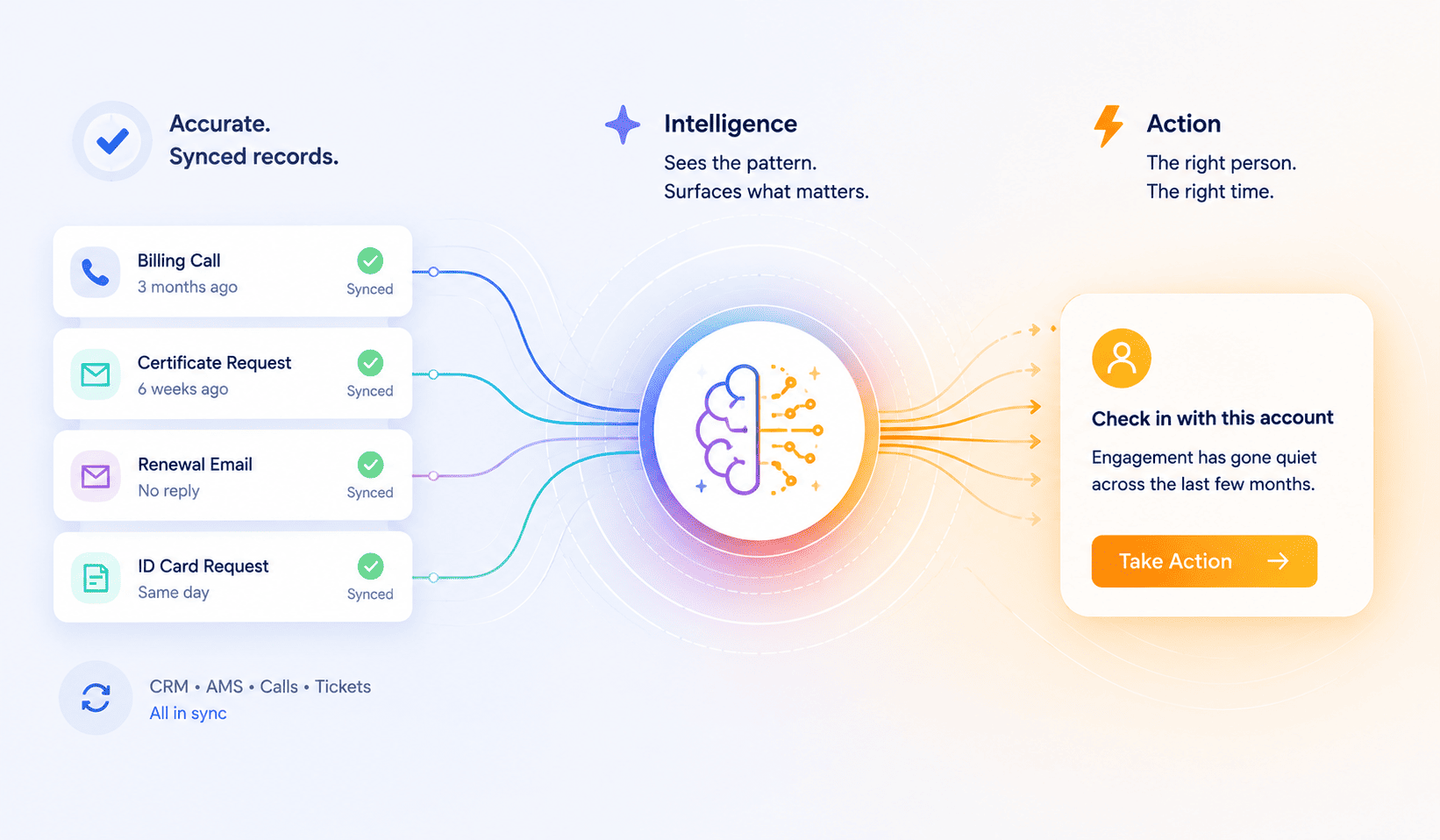
Every system faithfully records what reaches it. The problem is everything that never does, the call that never gets logged, the text that never syncs, the reminder that lives in one person’s calendar instead of the agency’s workflow. Switch AMS platforms entirely, and the day after migration, this is still true. Changing where the record lives doesn’t change what reaches it.
Why "log it better" doesn't fix it
The obvious answer is “log everything.” But logging asks people to do two jobs at once- have the conversation, and narrate it for the record, in real time, on top of the job they were actually hired to do. That’s sustainable for a week. Not for years. This was never a discipline problem. It’s a memory problem, and memory was never something an agency should have had to depend on a person for.
Every agency has a second book
This one lives inside people’s heads. The promises, the mentions, or the “I’ll call you back” that never made it to a screen. Most agencies don’t realize they’re running on two books until the day the two stop agreeing with each other, and by then it’s a client on the phone with a competitor, not a note in a file.
The day those two books become one book, execution stops depending on anyone’s memory.
That’s where this goes next.
Wondering how many of these gaps exist in your own book?
You don’t have to wait for the next post. Schedule a demo and we’ll walk you through what it looks like for you.