

 NPS
NPS


Has anything actually changed since your agency adopted AI?
Not what you bought. What changed.
The Pressure to Say Something
Over the last two years, almost every agency has adopted some form of AI.
A chatbot on the website. An “AI-powered” feature in the CRM. A note in the newsletter about embracing the future. Maybe all three.
That isn’t surprising, considering every agency owner has been surrounded by the same message everywhere they look. Vendors lead with AI. Conferences build tracks around it. Carriers ask about it in QBRs. Competitors add it to their websites whether it’s changing the business or not.
According to BCG’s AI Radar, AI spending in property and casualty (P&C) insurance is on track to triple as a share of revenue in 2026- but only 38% of P&C insurers report generating value at scale from it in core workflows. The pressure underneath is real: rising claim costs are squeezing margins industry-wide, and customers now expect quoting and service to move at the speed of everything else they buy online.
That gap between spending and substance isn’t a vendor problem or an agency problem. It’s the industry’s current default setting.
Saying “we’re using AI” has become its own proof of relevance, regardless of what’s running underneath. Gartner calls it an “enablement illusion,” where basic access or adoption metrics is often mistaken for actual transformation- draining ROI.
Feature vs. Operation
Having an AI feature and running an AI-powered agency are not the same thing.
“Across the software industry, AI adoption numbers remain lower than many expected. Some view that as a technology problem. I don’t. I view it as a design problem.” -writes Raution Jaiswal, CEO of InsuredMine. The full piece is worth a read if you haven’t seen it.
Real adoption is often quieter.
A system that knows which renewal is at risk before anyone has to check, because the signals- no recent contact, a lapsed payment, a competitor quote search – were already in the data. A producer who throws out the call-back spreadsheet, because the platform already knows who needs it and when. None of that makes a good demo. It just makes the work faster, quietly enough that nobody calls it AI anymore. It’s just how the work gets done.
Where the Gap Sits
Between signal and substance, five points roughly mark the path: watching from the sidelines, adopting a tool – sometimes to be seen adopting it, bolting a tool onto an existing workflow without changing the workflow, rebuilding the workflow around what the tool makes possible, and running on it without thinking about it at all.
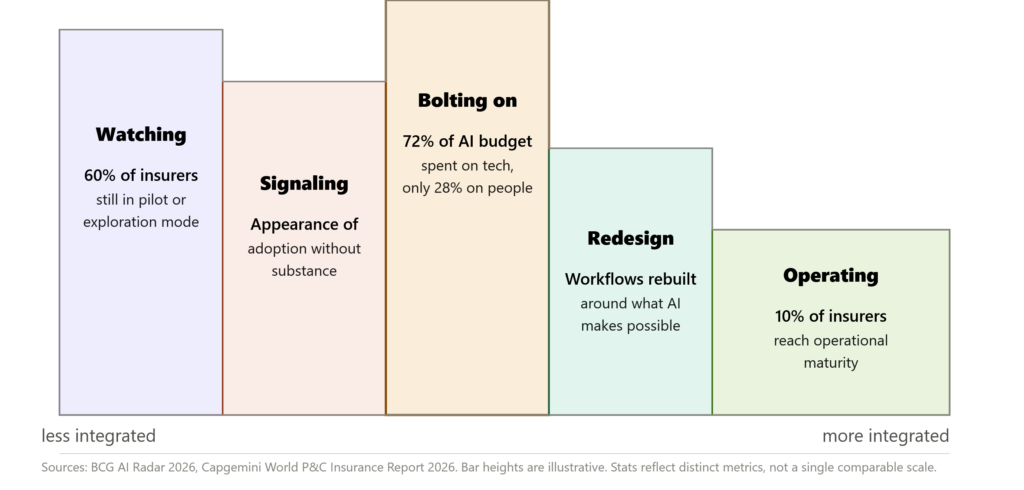
The gap is almost always at the third point. Bolting on is the easiest stage to get stuck at – it produces visible activity, a new tool, a new dashboard, a new login, without requiring anyone to rethink a single process. It looks like progress. It feels like progress. The workflow underneath hasn’t moved. The AI is only adding a step, not removing one.
Capgemini found the same pattern in the budget: P&C insurers, on average, put 72% of their AI investment into technology and only 28% into change management. The tool gets funded. The work of rebuilding around it doesn’t.
The Way Forward
Agencies often measure adoption by what they bought. Picking apart a past decision doesn’t go far either. The more useful test looks forward: before the next AI tool gets adopted, ask what specifically would be different in how the team works because of it.
This is what agents themselves are already asking for. Recent research from Cake and Arrow found that agents and brokers aren’t resistant to AI or asking for more automation – they want tools that fit how they already work, not another login to manage.
That’s the forward-looking test in one sentence: does this fit the work, or does the work now have to fit it?
A concrete answer is a good sign. A vague one is a flag worth noticing before the purchase, not after.
The fix, in practice, runs backward from how most agencies approach it. The instinct is to find a tool and then figure out where it fits. The better move is to find the one place where the work actually breaks – renewals slipping through, follow-ups getting missed, the same customer data living in three siloes that don’t talk – and rebuild that single process end to end before buying anything else. Not five tools bolted onto five workflows. One workflow done properly. The rest can wait.
It’s part of why we’re building the next version of InsuredMine around this exact distinction. Not AI bolted onto existing screens after the fact, but a platform designed from the ground up to work as a thoughtful assistant inside the day, not another thing to check. Less to manage. More that happens on its own.
AI won’t transform agencies because they bought better software. It will transform agencies when better software changes how work gets done.