

 NPS
NPS


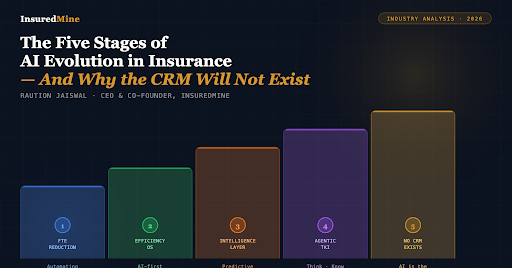
From FTE reduction to the complete dissolution of the CRM — how AI is not just transforming insurance agencies but cannibalizing its own earlier versions faster than any technology in history. Here is the honest map of where this ends up, and what independent agents must do at every stage.
Every technology wave in history has followed a predictable arc: automate the mundane, accelerate the capable, then redefine the possible. What makes AI in insurance genuinely different is not the destinations on that arc — it is the speed. And more startlingly: the way AI is consuming its own previous versions to get there faster.
At InsuredMine, we serve 14 of the top 50 independent P&C agencies in the US — some of the most relationship-driven, process-dependent businesses in America. From that vantage point, we have watched AI move from conference keynote buzzword to an operational reality reshaping agency life month by month. This article is not a sales pitch. It is an honest map of where the technology is heading — and a candid look at how that compares to the growth curves of the internet, smartphones, and cloud software before it.
Some of what follows is exciting. Some of it is genuinely unsettling. All of it is real, and all of it is coming faster than the industry is prepared for.
Already seeing AI reshape your agency?
See how InsuredMine’s AI-powered CRM helps independent agencies prepare for every stage of this evolution.
The Five Stages of AI Evolution in Insurance
The evolution below is not a linear feature roadmap. It is a fundamental restructuring of what an insurance agency is and what work it performs. Each stage makes the previous one look like a prototype — not because the earlier version failed, but because AI’s own growth rate demands it be replaced.
Where Is Your Agency on the Curve?
Stage One · Now · Active
FTE Reduction — The Automation Wave
This is the stage most independent agencies are either entering or mid-stream in today. AI-driven workflows — policy summaries, automated renewal follow-ups, intake automation, AI-drafted emails — are eliminating tasks that previously required dedicated headcount. The arithmetic is blunt: what once required three CSRs can in many cases be handled by one person augmented by AI.
Entry-level data entry, first-touch prospect communication, policy change acknowledgments, ACORD form pre-population — these are going first. The risk for agencies moving too fast is losing institutional knowledge along with the FTE. The opportunity is reinvesting those savings into producer capacity, client experience, and geographic expansion.
The question is no longer “should we adopt AI?” It is “how do we manage the human transition without losing what makes us trusted advisors?”
Stage Two · 12–24 Months
Efficiency — AI as the Agency Operating System
Stage Two is not doing the same work with fewer people. It is restructuring how work flows through the entire agency. AI stops being a feature and becomes the backbone: workflows are AI-first, handoffs are AI-orchestrated, and decisions about which accounts to prioritize, which renewals are at risk, and which prospects convert are driven by predictive models — not gut instinct and aging spreadsheets.
The agencies that will win Stage Two are those investing now in clean data, native AMS integrations, and AI-literate staff. This is why integrations with Vertafore’s AMS360, QQCatalyst, and NExsure are not optional plumbing — they are the strategic substrate on which Stage Two is built.
Agencies at Stage Two maturity serve 35–45% more accounts with the same team. The efficiency gain is structural, not marginal. It changes what a healthy agency looks like on a P&L.
Stage Three · 2–4 Years
Intelligence — AI That Knows Your Book Better Than You Do
Stage Three is where the technology becomes genuinely profound. This is AI that does not execute instructions — it understands context, recognizes behavioral patterns across thousands of client interactions, and generates intelligence no human analyst could produce at speed or scale.
Picture a system that identifies not just which policies are renewing in 60 days, but which clients are statistically most likely to shop — based on claim frequency, payment behavior, life event signals, carrier pricing trends in their ZIP code, and email engagement patterns — all synthesized in real time, surfaced as a daily priority list before a producer’s morning stand-up.
At Stage Three, the producer’s job changes entirely. You no longer manage tasks. You manage relationships that AI has pre-qualified, pre-briefed, and pre-loaded with context before you pick up the phone. The conversation becomes the only thing that matters — because AI has already handled everything else.
Stage Four · 4–7 Years
Agentic AI — TKI: Think. Know. Initiate.
Stage Four is where the paradigm breaks. Agentic AI systems do not wait to be prompted. They operate on a three-part framework we call TKI: Think, Know, Initiate. They think through what action is appropriate based on current context. They know the client, the policy, the market, and the agency’s relationship history. And they initiate — without waiting for a human trigger.
An agentic insurance AI does not remind a producer about a renewal. It has already analyzed the client’s coverage gaps, cross-referenced live market pricing, drafted three tailored renewal options, sent a personalized pre-renewal touchpoint, scheduled a call on the client’s calendar, prepared the producer briefing document, and flagged two cross-sell opportunities — before the producer’s first coffee.
At this stage, the role of the producer becomes pure relationship stewardship, complex risk judgment, and emotional intelligence. The entire policy lifecycle administration — for straightforward accounts — is fully AI-owned. This is not augmentation. This is delegation at scale, and it forces a complete redefinition of agency staffing, compensation, and organizational structure.
Stage Five · 7–15 Years
The CRM Does Not Exist — AI Is the Agency
The most honest and radical claim in this article: the CRM as a distinct software category will not exist in Stage Five. Not because agencies stop managing relationships — but because relationship management will be so deeply embedded in ambient AI infrastructure that a separate “CRM system” will feel as antiquated as a Rolodex does today.
In Stage Five, the agency is an AI entity with licensed human professionals at the center of high-stakes moments. The boundaries between CRM, AMS, quoting engine, client portal, analytics platform, and communication tool dissolve into one intelligent, context-aware layer that simultaneously knows every client, every policy, every risk profile, every market movement, and every regulatory nuance.
The agency of Stage Five resembles a boutique advisory practice more than a traditional distribution operation. Small headcount. Extraordinary revenue per head. Extraordinarily deep client relationships. The entire commodity insurance lifecycle — placement, servicing, renewals for standard accounts — is automated end to end.
What endures is human judgment in complex risk, advocacy in claims situations, and the irreplaceable trust built over years of genuine relationship. That is the durable core of what independent agents have always offered — and in Stage Five, it is the only thing they need to offer.
AI Is Cannibalizing Itself — The Self-Obsolescence Curve
Here is what no one is saying loudly enough: AI is eating its own earlier versions faster than any technology in history. The AI tools that felt transformative in 2023 are already legacy compared to what emerged in 2025. The models released in early 2026 make their 2024 predecessors look like dial-up internet. And the replacement cycle is not measured in years anymore — it is measured in months.
This creates a strategic paradox for insurance agencies: the AI investment you make today may need to be rebuilt in 18 months. But the alternative — waiting for the technology to stabilize — guarantees that you will fall structurally behind agencies that are learning on earlier versions and accumulating the data advantage that makes future AI systems valuable.
The pattern has a name in technology economics: creative self-destruction. Each generation of AI tools does not supplement the previous generation — it obsoletes it. Here is how that plays out specifically in insurance AI:
Being Obsoleted
Early AI Features (2022–2024)
- Rule-based chatbots and IVR
- Template email sequences
- Static renewal reminder triggers
- Manual data entry with OCR assist
- Keyword-based lead scoring
- Scheduled social media posts
- Single-channel follow-up automation
Replacing Them
Current & Next-Gen AI (2025–2026+)
- Conversational AI with context memory
- Personalized, generative 1:1 communications
- Behavioral churn prediction models
- Full document ingestion and extraction
- Intent-based, multi-signal lead ranking
- AI content strategy with SEO optimization
- Omnichannel orchestration, autonomously timed
The implication for agency owners is uncomfortable but important: the “AI strategy” you built in 2023 may already be your legacy system. The agencies that thrive in this environment are those with the organizational agility to upgrade continuously — not those who locked in a single vendor’s vision of what AI would look like.
“The most dangerous position in AI adoption is not moving too slowly. It is investing so deeply in a first-generation solution that you are reluctant to upgrade when the second generation makes it obsolete. That reluctance is where agencies will fall behind — permanently.”
— Raution Jaiswal, CEO, InsuredMine
This is also why platform architecture matters enormously. An AI solution built on a closed, proprietary stack becomes a ceiling. An AI-augmented CRM built on open data standards, modular integrations, and an upgradable AI layer becomes a launchpad — because you can swap the AI engine without losing the data asset underneath.
AI Adoption Compared to Every Major Technology Shift
To understand what is happening now, it helps to compare AI’s adoption velocity to the technology revolutions that came before it. The pattern is consistent — but AI’s curve is steeper than anything that preceded it.
Technology Adoption Curves — Years to 50% Market Penetration
Comparative rate of enterprise adoption across major technology waves · Index: 0 = commercial introduction
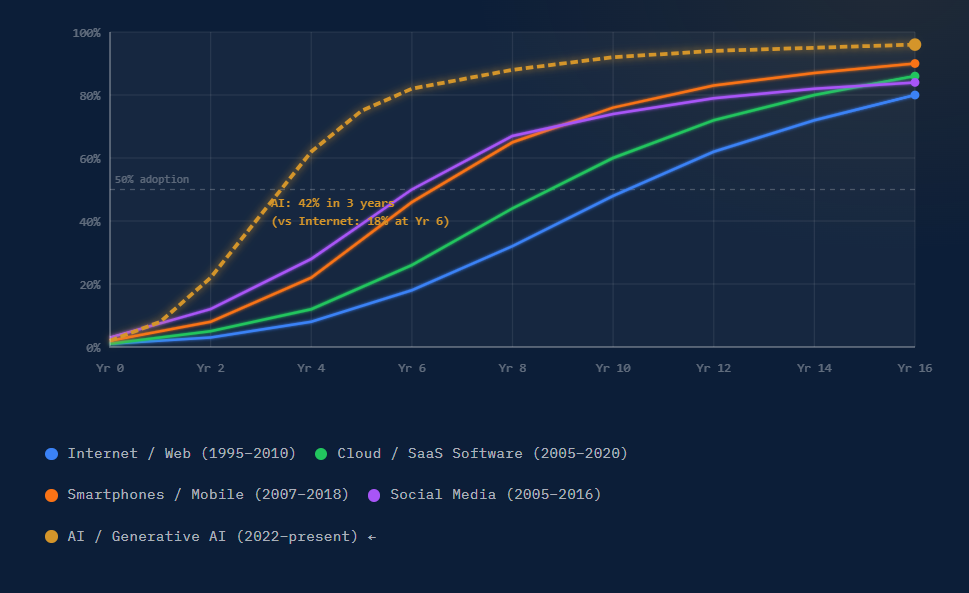
The critical observation is not just that AI is being adopted quickly — it is that AI is compressing the cannibalization cycle. The internet took 15 years to obsolete the fax machine. Cloud software took 10 years to make on-premise servers feel archaic. AI is making its own 2023 versions feel outdated in 18 months. This is not merely fast adoption. It is a fundamentally different self-replacement dynamic driven by the recursive nature of AI training itself: each new AI generation uses the data, patterns, and outputs of the previous one to surpass it.
For insurance technology specifically, this means the window of competitive advantage from any single AI implementation is narrowing. The moat is no longer the tool — it is the data, the relationships, and the organizational learning embedded in how an agency uses the tool.
InsuredMine AI — Today
What InsuredMine Has Already Built for Your Agency
InsuredMine’s AI features are not a roadmap promise. They are live tools used today by independent P&C agencies managing millions in premium across the US.
Sherpa Virtual Assistant
IM-certified AI-backed virtual assistant service handling client communications, policy servicing, and follow-ups — with human accountability built in. Your AI teammate, not your replacement.
AI Renewal Workflows
Automated renewal pipelines that trigger multi-touch sequences 90, 60, and 30 days out — personalized by policy type, client history, and carrier pricing signals
Sales Pipeline Intelligence
AI-scored lead pipelines that surface the highest-priority opportunities daily — ranked by conversion likelihood, coverage gap signals, and producer activity history.
AI Email & SMS Automation
Generative communication sequences that sound like a relationship, not a template — dynamically personalized by client segment, policy status, and engagement behavior.
Native AMS Integrations
Deep, two-way data sync with AMS360, QQCatalyst, and NExsure — so your AI works from a single source of truth, not siloed data. The integration layer that makes Stage Two possible.
Policy Gap Analysis
AI scans your book for coverage gaps and cross-sell opportunities by household — surfacing proactive conversations before clients discover the gap through a claim.
Retention Prediction
Behavioral scoring that identifies at-risk accounts 90 days before renewal — based on engagement patterns, claim history, premium sensitivity, and market signal
AI-Assisted Intake & ACORD
Reduce intake friction with AI-pre-populated ACORD forms, document extraction, and smart field mapping — cutting new business processing time by up to 60%.
Already seeing AI reshape your agency?
See how InsuredMine’s AI-powered CRM helps independent agencies prepare for every stage of this evolution.
What Your Agency Should Do Right Now
The five-stage framework is not a passive prediction — it is an invitation to act at Stage One in ways that compound through Stages Two, Three, Four, and Five. Here is the concise agenda for independent agency owners:
Every incomplete contact, every unmapped account relationship, every offline renewal note is a structural liability in an AI-driven future. Data cleanup is ROI now, not later.
AMS and CRM that don’t share data cannot be intelligently orchestrated. Native integration is Stage Two’s entry fee. Pay it early.
Your team needs to learn how to work with AI outputs — when to trust them, when to question them, and when human judgment is the only right answer.
Stop measuring producers by call volume and activity counts. Start measuring by relationship depth, revenue per client, and retention rate. Stage Three rewards a different skill set entirely.
Build your AI stack on open, modular architecture so you can upgrade the AI engine without losing the data asset underneath. Avoid lock-in to first-generation AI tools.
Every interaction, every touchpoint, every outcome logged in your CRM today becomes training signal for the predictive intelligence you will need at Stage Three. Do not underlog.
What AI Cannot Replace — And Will Never Replace
Five stages of AI evolution does not mean the end of the independent agent. It means the end of the independent agent doing administrative work a machine can do better. What it leaves untouched — and actually amplifies — is the deeply human dimension of insurance.
When a small business owner faces a catastrophic claim and needs someone to fight for them with the carrier: that is a human moment. When a family goes through a life transition and needs someone who understands their full picture, not just their policies: that is a human moment. When a complex commercial risk requires creative placement across multiple carriers with nuanced underwriter relationships: that is a human moment.
These moments will not go away. In a world of AI-automated commodity insurance, they will become rarer — and therefore more valuable. The agencies that position themselves as the human intelligence layer on top of AI infrastructure will occupy the most defensible, most profitable position in the independent channel.
That has always been InsuredMine’s north star. Not the software. The agency. Not the CRM. The relationship. The technology evolves. The mission does not.
Where Is Your Agency on the Curve?
InsuredMine works with independent P&C agencies at every stage of AI evolution — from first implementation to building toward a fully intelligent agency model. Let’s find out where you are and map where you need to be.