NPS
NPS


Your Producer Logged the Call. Did Epic Ever Hear About It?
A single day’s activity, and the people on the other end of it.
“Can you remind me what we talked about last week?”
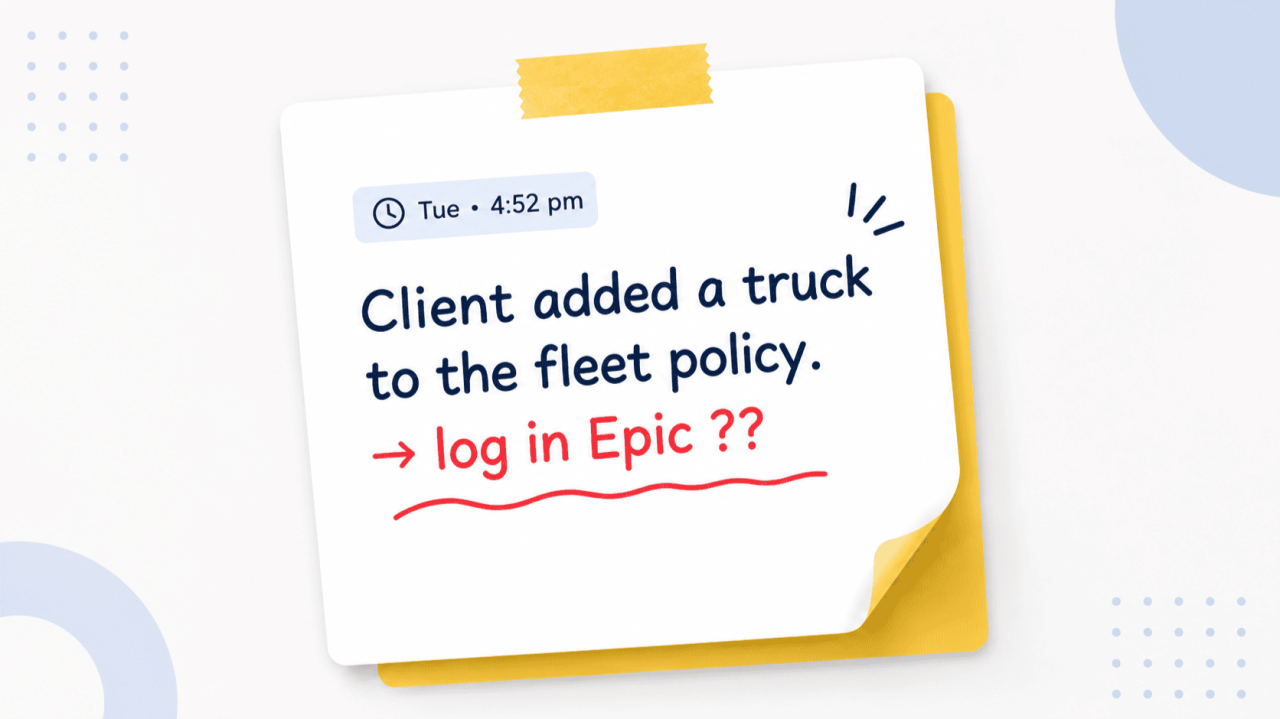
It’s a small question, and a client should never have to answer it. But in a lot of agencies they do — and the reason traces back to a twenty-second phone call that never left the producer’s CRM.
Start with the call — at Marcus’s agency in Florida. One of his producers takes it on a Tuesday afternoon: a client adding a driver, or asking about a commercial renewal. He logs it, sends a follow-up text, drops a note on the account, and moves on. Everything he did, he did in the CRM. And at Marcus’s shop — like a lot of agencies — that’s exactly where it stays.
Here’s why. Marcus’s CRM connects to Applied Epic the way most do: it pulls data one way, Epic → CRM, usually overnight. Accounts and policies come in; nothing goes back.
So that producer’s note, his call, his text sit in a system Marcus’s service team doesn’t work from. Three weeks later, a CSR opens the account in Epic to handle the renewal — and the conversation isn’t there. She calls the client to catch up. The client repeats themselves. Most of the time it’s minor friction. Once in a while it’s a missed change, a wrong assumption, a file that doesn’t match what was actually agreed.
Now walk into Dana’s agency in California — three time zones west of Marcus.
The same Tuesday, a different downstream. Dana’s producer takes the same kind of call and logs it right from the Account 360 page he’s already looking at. It’s in Applied Epic in real time — under the correct account and policy. Not tonight; now.
Whether it’s a call, an SMS, a note, an email, a task, or an eSignature, it flows — automatically or on demand, whichever the agency configured — and a small “Applied Epic / Synced” tag confirms it landed. It runs both ways, too: anything logged in Epic shows up in InsuredMine just the same.
Meet Carmen, one of Dana’s CSRs. When she opens that account three weeks later for the renewal, the producer’s note is already there — sitting in the system she actually works from. She doesn’t call the client to ask what they already said. She picks up exactly where the producer left off: same account, same story, no seam. The client experiences one agency that remembers them, not three systems that don’t talk to each other.
That’s the real product of activity sync — and it isn’t software. It’s the CSR who looks prepared instead of lost. It’s the renewal that carries its full history into the conversation. It’s a Friday that ends on time. None of it is dramatic — and that’s the tell of a real integration: it removes the work you never see, so the record, and the client relationship on top of it, stays whole without anyone thinking about it.
Dana closed this gap two years ago. Her team hasn’t thought about it since. Carmen has never known the version where the note isn’t there. That’s what “closed” looks like from the inside — not a feature people talk about, but a friction that quietly stopped happening.
That’s the question Marcus is sitting with — and it might be yours too: when your producer logs a call, does Epic ever hear about it? If the honest answer is “eventually, if someone remembers to re-type it,” the gap is already costing you — in small moments now, and occasionally in a big one later.
Next week, we’ll look at the upgrades that make closing this gap almost effortless — pulling an Epic account into the CRM in under a minute and letting a closing deal sync itself.
See it against your own Epic data — book a 20-minute walkthrough: Contact us here.
Or find us at Booth 231, AppliedNet 2026 — the Gaylord National Resort, National Harbor, MD — this September.